On In Copula, Ebril (pronounced ehh-BRILL) finds freedom exploring the relationships between flora and fauna, taking listeners on a journey from dawn to dusk. Connecting to nature and to herself, the intimate, textured, album blends folk, lo-fi, and shoegaze, combining acoustic and electric instrumentation into a cohesive and immersive ambient sound.
Ebril released In Copula in January of 2025. By the summer, her dreamy lo-fi breakout track “Stranger in You,” had gone viral, inspiring more than 240,000 creations across all platforms, and generating more than a billion cumulative views. The song has since surpassed 10 million global streams across DSPs, with In Copula now racking up over 1 million weekly streams on Spotify alone. On Nov. 10, 2025, Billboard Canada announced Ebril’s signing with Universal Music Canada. (Her debut album, Portals, was released in 2020.)
The album is a one-person project: Ebril handled every aspect of writing, performing, and recording, all from the comfort of her room, save for a few field recordings – from nature sounds to the bustling street markets of Jordan.
“I felt so strongly about music that I decided I wanted to learn,” she says. “I learned how to make simple beats through YouTube tutorials on GarageBand. I wanted to be a producer. I didn’t want to be a singer, or a songwriter.” A local teacher also played a big role in helping her develop her skills.
“If I open my window, it’s like opening my heart”
Brought up in a strict, religious household, 22-year-old Ebril – born Huda Al-Hamami – wasn’t allowed to go out after school. Seeking solace in her guitar and computer, she created music in her room, connecting to the wider world through both the internet, and by observing life outside her open window. She describes the experience of being in her bedroom, while listening to the world outside, as a “positive feedback loop.”
“I knew I wanted it to feel like I was in my room, so I recorded it in my room,” she says. “I don’t know how to explain it, but if I open my window, it’s like opening my heart. The sound of the world comes through me, comes out of me. It’s like an exchange in that way. And that’s what I wanted this album to sound like.”
In Copula is full of nature references and scientific metaphors, reflecting her fascination with the relationships and interactions that shape the world. Its title is drawn from a Latin biological term meaning “connection.” Her interest in science isn’t surprising, given her major in Environmental Studies at McMaster University.
What drove the viral song, the album, and her staggering success? Love. “Stranger in You” is about a childhood friendship that blossomed into a romance in university. Although Ebril did her best to love the person even as they grew apart, the relationship ultimately didn’t work out. Still, she says, “It’s always worth it to love. It’s never a waste of time, even if your love is unrequited, because your love is independent of anything else. It’s from you. It has to do with you, and it’s a teller of who you are.”
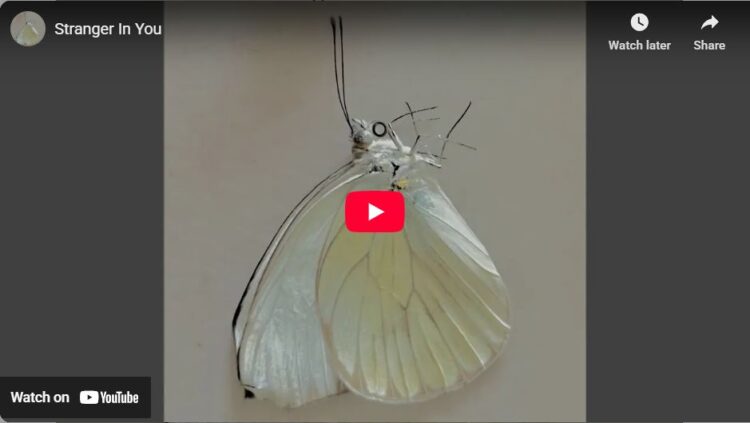
Select the image to access the video of the Ebril song “Stranger in You”
In Copula features songs Ebril wrote between the ages of 15 and 20, capturing emotions that range from wistful, to hopeful, to a tender kind of innocence. Though they were written over several years, their collective meaning can be succinctly summarized in a lyric from “Sugar Maple.”
“I have one line that I think encapsulates the feeling of this entire album,” she says. “‘It’s hard to be like a tree / And stand tall for the birds / To sit upon and sing / Their pretty songs to me.’” After a pause, she adds, “You know, that’s 16-year-old me wishing I had friends. I wish I was a tree like a sugar maple, that had sweet sap that all the birds wanted to come and be around. I was just such a lonely kid.”
Ebril was born in Iraq, but when she was two years old, the Iraq War prompted her family to move to Jordan, where they made many happy memories. They moved to Canada when she was nine. Her family visited Jordan regularly, and when they left, at the end of each stay, Ebril found herself heartbroken at the prospect. But after a four-year gap in these journeys, she knew things would be different when she returned as a 20-year-old.
“I knew it wasn’t going to feel like home,” she says. “I was going to feel like a foreigner there, even though I always feel like a foreigner in Canada; less so now because I found a community here.” The conflicting feelings she experienced are expressed in her song “Anticipate Heartbreak.” She says, “I was anticipating that heartbreak, that somehow my home country was going to become a stranger.”
She speaks excitedly about the songwriting process: “Sometimes songs just download, they come from somewhere. And when I touch the guitar, it just comes out. Sometimes the process is that easy. It flows like water. I feel like maybe you’re so in tune, or intuitive in yourself, that your subconscious knows something you don’t consciously know, that through art, you’re able to express.”
“Sometimes songs just download, they come from somewhere”
Main and background vocals are always the last part of production. “Vocals are pretty difficult for me to record, just because my setup is always changing, and I don’t record in studios,” she says. Ebril records and mixes the tracks while hearing the vocal melodies in her head. “When I produce a track and then I sing over [it], and I realize there’s parts that are clashing with the vocals, I’ll take them out,” she says. She writes one song at a time, until she feels something akin to euphoria – a signal that the song or album is finished.
Music has been a longtime obsession for Ebril. “I think you’re always learning, you never stop,” she says. “Sometimes I dreamed bigger than my skill set. And I still do. But it’s not a bad thing. I worked super hard to execute, as close to possible, what I wanted.”
The girl, and later young woman, making music in her room was looking for a way to connect, and feel a sense of belonging. Of In Copula she says, “I built the world I needed.”