Founded in 1976, Quebec’s best-known roots band is writing a new chapter.
The harvest has been plentiful; the roots of traditional Quebec music have borne fruit. And now, half a century later, La Bottine Souriante is still standing. Not bad for a band from Lanaudière.
While La Bottine Souriante’s early albums (Y’a ben du changement, Les Épousailles, Chic & Swell) are prized by collectors, the band’s recipe and its trademark sound has evolved over the past five decades.
“La Bottine has become bigger than its members,” explains Jean-François Gagnon-Branchaud, who has been part of the band for 16 years as a multi-instrumentalist, singer and arranger. “Everyone who joined brought s
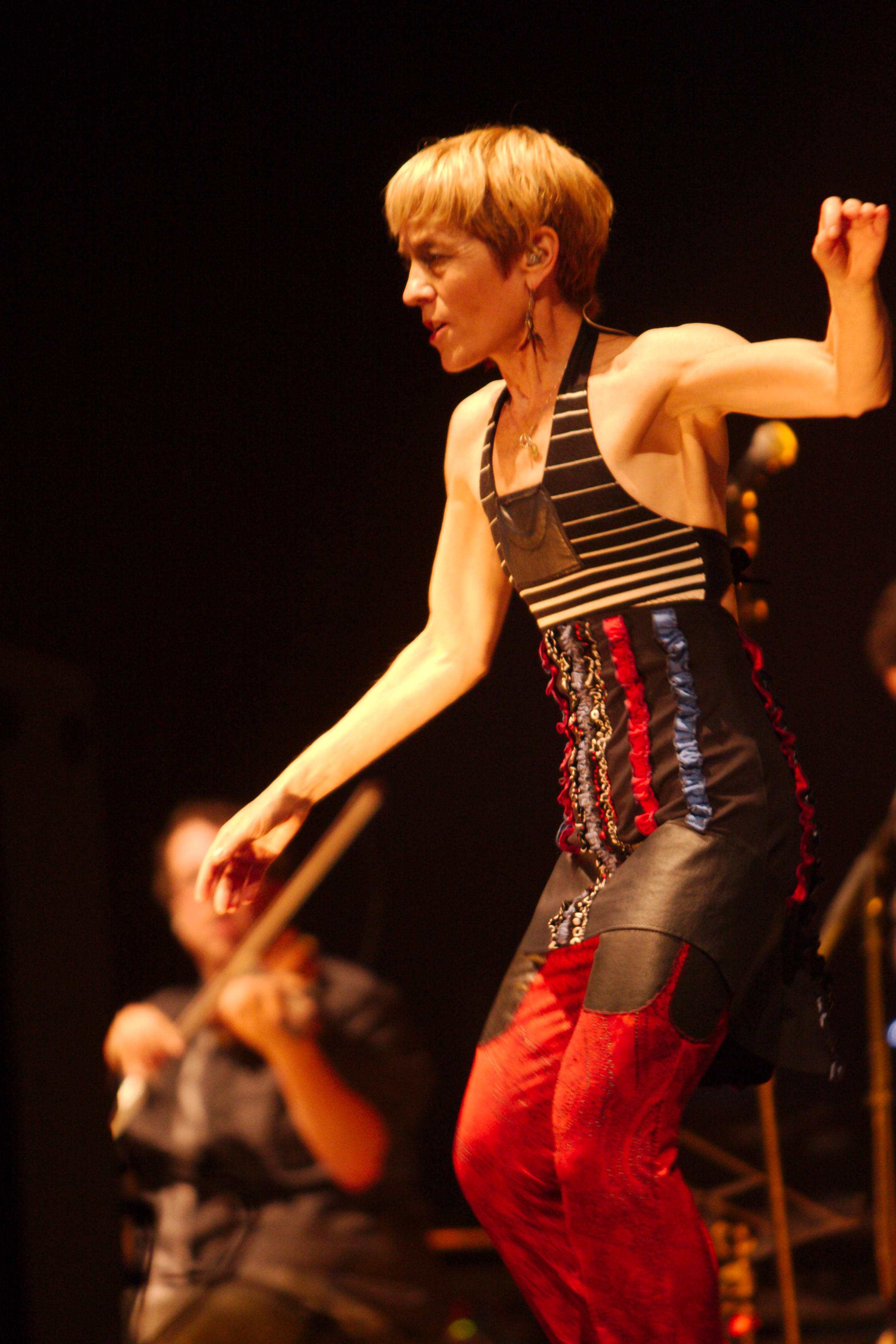
Sandy Silva in 2025. (Photo: Pete Grubb, Flickr)
omething of their own so La Bottine could keep evolving. We didn’t want to become a cover band playing the group’s greatest hits.”
So, at its core, the music of the “terroir,” with all its many forms, constitutes their raw
material: foot percussion, handclaps, and the endless possibilities OF call-and-response songs. There is no doubt that the Lanaudière bards have a vast palette to draw from.
Since 1991, La Bottine Souriante has added horns to the mix, not to mention the ever-present Sandy Silva onstage—the spirited tap dancer whose steps fly as freely as her smile. She was not, however, the first woman to join the illustrious collective: Lisa Ornstein had a brief stint in 1978-79.
Roots and Wings
With Domino!—its 14th album released in 2023 and honoured the following year at the ADISQ Gala with the Félix for Traditional Album of the Year—the group put its unmistakable stamp on a landmark body of work while showing just how far it has come over a 50-year career.
“In Quebec,” says Gagnon-Branchaud, “we’ll occasionally hear comments from nostalgic fans who miss La Bottine before the horns… and with Yves [Lambert]. But elsewhere, audiences see the band for what it is today. That’s the audience that gives us the true pulse of our live show, because they haven’t followed every lineup change over the years.”
With a bit of hindsight, listening to their latest collection of songs makes it clear that they are a joyful convergence of chance encounters and necessary detours along the back roads of Lanaudière—the cradle of Quebec’s traditional music and its evolution since time immemorial.
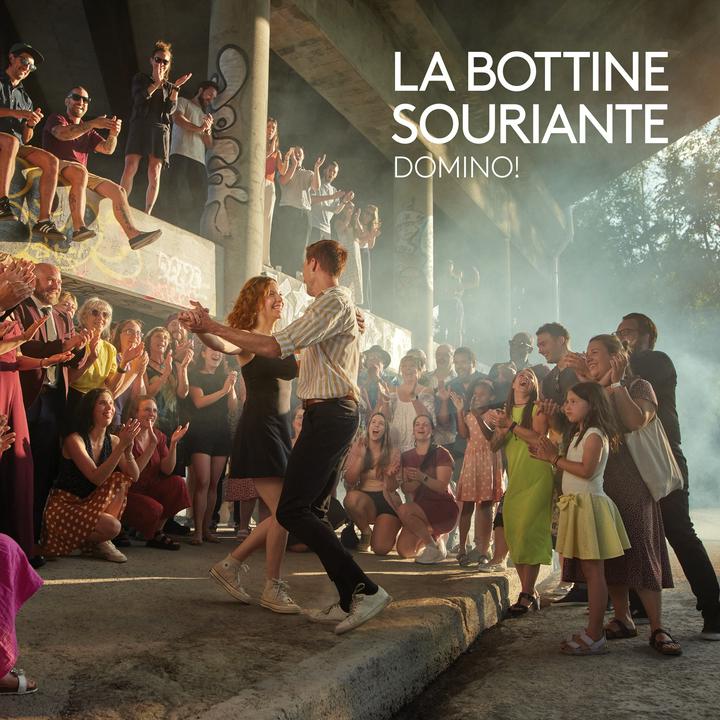
The 11 tracks on Domino! were released on the LABE label and recorded at Studio B-12 in Valcourt, in the Eastern Townships—a place that, over the years, has become fertile ground for creative residencies (Sept jours en mai, the country project Grande Ourse, Alphonse Bisaillon, Klô Pelgag, Les Louanges, etc.).
No showboating or endless solos on Domino! Everything is finely calibrated and flows naturally. Enticing tracks like Les Jolies Québécoises—which tips its hat along the way “to the city girls from Anjou” —, La wagine and Tralala make you want to dance, or, at the very least, tap your big toe. The beloved and generous Bottine sound is immediately recognizable as carrying forward an already remarkable body of work.
The songs are built on simple frameworks and carried by the strength of the players, even in the genre’s most elemental forms, and that explains why interest in La Bottine shows no sign of fading.
Ultimately, La Bottine Souriante went back to the source to explore what makes this music universal, and how it continues to resonate today. Like others of its generation, the group has carefully and respectfully drawn from the deep roots of traditional music, while giving it a voice all its own. That is something to admire.
Third Generation
Several Bottine Souriante veterans are no longer with us. Mario Forest, who died last year, was not only one of the group’s founders, but also the driving force behind the Festival Mémoire et Racines, as well as multi-instrumentalists Gilles Cantin and Denis Fréchette, and trumpeter Laflèche Doré.
Yves Lambert, who is very much alive, was once the group’s central figure, having co-founded the band before leaving in 2003. Gagnon-Branchaud explains it this way: “Yves left after a serious dispute or falling-out with the band that was never resolved, and that’s why he isn’t part of our show.”
As we know, Lambert went on to pursue several solo projects, including the album Les vacances de monsieur Lambert and Le Bébert Orchestra. This year, he is touring his own show, 50 ans, de La Bottine à aujourd’hui.
When he joined the band 16 years ago, Jean-François Gagnon-Branchaud jumped aboard a train already in motion. Originally from Saint-Côme, and trained in jazz and bass, he too grew up to the sound of La Bottine’s traditional music. In the same spirit, his other group, Hommage aux aînés, revisits the musical folklore of his village. “They’re kind of like the Rolling Stones of roots music,” he says by way of comparison.
How did he become a member of the band?
“I was filling in for guitarist Éric Beaudry. I was in and out of the group for three years. Then, in 2010, on my birthday, while we were on tour in France, the moment I’d been waiting for finally came: they asked me to join La Bottine full-time. It always felt like you had to wait for someone to leave before you could take their place.” At that point, the lineup grew to 11 musicians.
Jean-François Gagnon-Branchaud brought a deep grounding in traditional repertoire. He is nothing if not versatile, and he sings, plays the guitar, the accordion, the fiddle and tutti quanti.
A Colossal Musical Heritage
La Bottine Souriante has achieved a great deal, with boldness and conviction. Rooted in its culture, its language and a deep knowledge of the musical lineage that gave rise to Quebec roots music, the band helped blaze a trail that others would follow, including La Volée d’Castors, Le Vent du Nord and Les Charbonniers de l’enfer.
Even today’s hottest act has felt that pull.
Angine de Poitrine, currently probably the hottest act in the world, recently nodded to the roots repertoire during a concert in Rovereto, Italy. When the dada-cubist mantra-rock duo took the stage, Khn checked his intriguing pedal board while Klek stretched, all to the sound of a typically Québécois call-and-response song, “Les jours de la semaine” by Les Charbonniers de l’enfer, recorded in 1996 on Mille-Pattes, La Bottine’s label at the time. Two full minutes of our musical heritage, in full rigodon mode, before a stunned Italian audience.
La Bottine for All Ages
The 50th anniversary tour will revisit every era of La Bottine Souriante, and Gagnon-Branchaud doesn’t even try to hide his excitement. “We’ve put together an a cappella medley that covers about 90% of the band’s different periods,” he says.
At the extragavanza planned for the Francos de Montréal, Lisa Leblanc is sure to make a memorable appearance, and as a bonus, two pillars of La Bottine, André Marchand and Michel Bordeleau, both no longer part of the collective, will also be there for the celebration, not to mention the extraordinary Jean Fréchette on saxophone.
“Obviously, we still really enjoy playing the classics like La tourtière, La poule à Colin, La Ziguezon and Le réveillon du jour de l’An, released as a 45 in 1987, and weaving them in with the newer songs. Traditional music is always evolving, and that’s the current we’re part of.”
In the early 1990s, la Bottine broke onto the international circuit after adding a horn section to the line-up. “That was the trigger for large-scale, high-profile shows in front of huge audiences.”
La Bottine Souriante is a trailblazer with a colossal body of work: 14 albums, three compilations and concerts around the world, especially in the United Kingdom and Spain — “our biggest markets, certainly, but La Bottine is huge all over the planet.”
The time has now come for a new audience to discover them—especially younger listeners, fans of rap, electronic music, chanson or indie rock. iT Is their turn to embrace the enthusiasm that radiates from this infectious music and its rebellious spirit, to understand its origins and the links between La Bottine Souriante and the music they listen to today.
“It’s incredible how well foot percussion is powerful in a sound system!” says the musician, referring to the overall, contagious effect of foot tapping over frameworks of folk and Celtic music.
Musicians are carriers of tradition: that is how connections are made and how history is written.
50th anniversary concert with La Bottine Souriante:
June 17 in Montréal (Les Francos)
On tour elsewhere in Canada:
August 14 in Edmundston (New Brunswick Botanical Garden)
October 10 in Rivière-du-Loup (Centre culturel Berger)
December 4 in Thetford Mines (Salle Dussault)
December 5 in Brownsburg-Chatham (PØLNOR)
December 18 in Québec City (Impérial Bell)
December 19 in Saint-Jérôme (Théâtre Gilles-Vigneault)
December 20 in Sainte-Agathe-des-Monts (Théâtre Le Patriote)
December 27 in Gatineau (Théâtre du Casino du Lac-Leamy)
December 28 in Magog (Le Vieux Clocher)
December 29 in L’Assomption (Théâtre Hector-Charland)