His music is political, even revolutionary—and his personal story has everything to do with it. Meet Jashim, one of the driving forces behind Montréal’s Latinx music scene.
Talking to Jashim feels a little like reading an adventure novel along the lines of Thélyson Orélien’s C’était ça ou mourir (It Was This or Die). His immigration story is remarkable: around the turn of the millennium, with the country at war, rebels in the jungle were targeting his father, so, at just eight years old, they had to flee his native Colombia. “He was chased and shot at because of the social work he was doing as a civil engineer in Chocó and the Amazon. And he survived… thanks to Life itself,” Jashim says.
“Because of the armed conflict and drug trafficking, a lot of people were losing their homes and being displaced. So my parents started a company to reclaim the land and rebuild homes for Indigenous communities and campesinos—people who work the land. Their only other option was moving to Bogotá, where many of them risked ending up on the streets. All told, my parents rebuilt about a dozen communities of 200 homes each.”
At this point, it’s probably clear as day: the urge to get involved, help others, and even change the world runs deep in Jashim’s DNA. It feels inherited, like a mission woven into the very fabric of his music and lyrics. In the “you had to be there” category, let’s mention his performance at La Noce festival, where he painted these words in red across a large white canvas onstage: “a system that has been written by men can certainly be unwritten”, while the songs flowed seamlessly into one another, like a DJ set at a club or rave. In the crowd, eyes widened and jaws dropped. Without missing a beat, Jashim had the Saguenay audience staring back at him in admiration. There, amid the ruins of the Pulperie de Chicoutimi, you could sense that those gathered there felt they were witnessing the emergence of something—or someone—important.
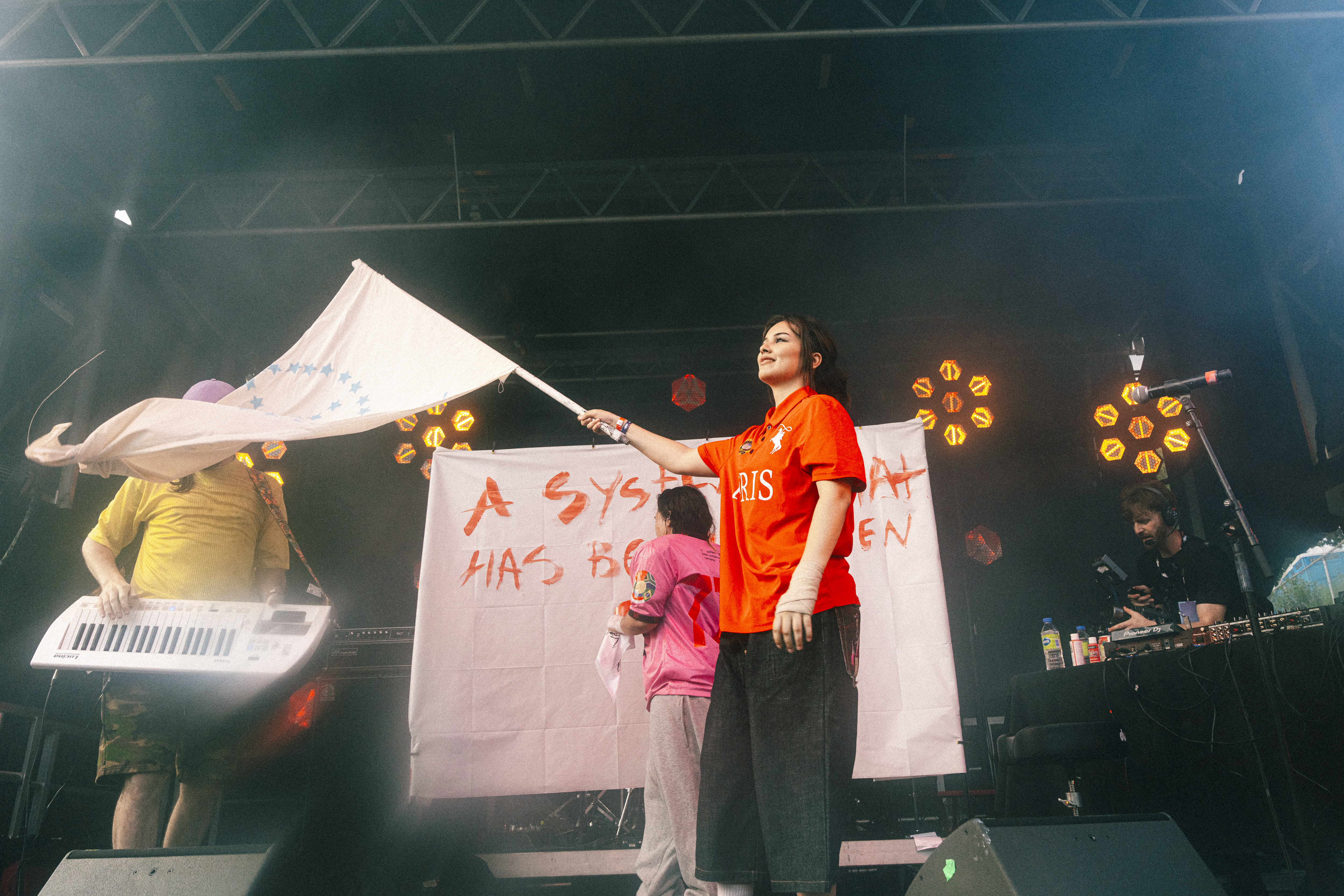
Jashim performing with his band at La Noce, in July 2026 (Photo by Charline Clavier)
Jashim’s electronic anthems feel like protest signs held high at a demonstration—acts of resistance in their own right. His message may be serious, but in person he radiates a joy for life, an almost irrepressible urge to smile. In the contrast between what he has to say and the way he moves through the world, he embodies a kind of resilience, a distinctly glass-half-full outlook. The light he carries doesn’t ignore the darkness; it simply refuses to give in to it. It shines through the boldest parts of his music, in its fluorescent, techno colours and in a body of work that also draws heavily on Afro-Colombian rhythms and neo-perreo. In other words, you can hear it loud and clear: Jashim hasn’t forgotten his roots.
Beyond Words
For Jashim, music is a second career—not exactly a late calling, but one that certainly caught him a little by surprise, with the pandemic acting as a catalyst. Stranded in Mexico with his then-girlfriend, he had an epiphany. It was through the musicians he met in Mexico’s underground scene that he finally gave in to his own impulses, started writing his own material and brought to life his futuristic, experimental, deliberately deconstructed pop in a form entirely his own.
Jashim recalls: “In Mexico, I met people who introduced me to Spanish reggaeton—the whole Yung Beef, La Mafia del Amor, Bad Gyal scene… When I discovered this whole side of Spanish-speaking culture that I hadn’t really known about, I thought, ‘Oh shit, maybe I can do this too…’”
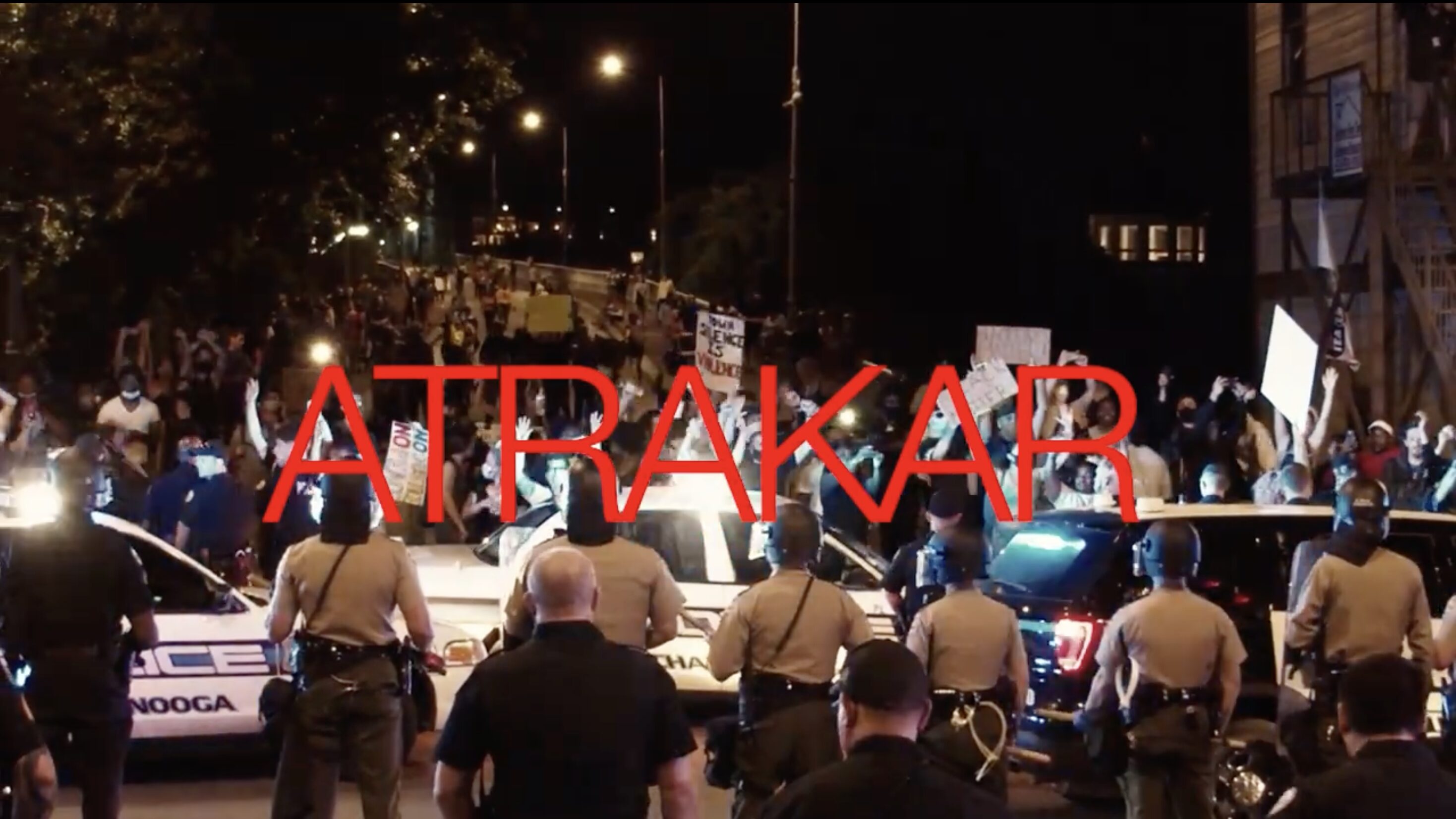
“ATRAKAR” by Jashim. Click the link for the video.
Before this realization that led him to take the stage with his own songs, Jashim was already immersed in creative work. He worked as a motion-capture specialist for Ubisoft, directing actors whose performances would become avatars controlled by gamers. More concretely, Jashim helped build games from major franchises, including Star Wars, Avatar, Assassin’s Creed and Tony Hawk.
That experience left Jashim with a deep interest in new technology. “I’d love to bring multimedia art and music together. My dream, really, would be to use holograms in my shows. I’d also love to create interactive installations.”
Between sets at Datcha and Système, two Montréal bars where he DJs regularly, Jashim is currently enrolled in Concordia University’s IMCA program, the Bachelor of Fine Arts in Intermedia (Video, Performance and Electronic Arts).
As if that wasn’t enough, he’ll somehow also find the time and energy to release his first full-length album, Lilvisions, in November 2026. Jashim clearly isn’t one to sit still, but considering everything he has accomplished and overcome so far, there’s little doubt he’ll make it through this latest rush without losing himself along the way. When it comes to the future, he’s a radical optimist—and in his mind, there’s not a shadow of a doubt: the best is yet to come.