When emigrating to Toronto from Ibagué, Colombia in 2015, composing film and TV scores were the last thing Andrés Galindo Arteaga had in mind.
“I didn’t arrive with like a concise plan or idea of having a career as a film composer,” Galindo Arteaga says from his Scarborough studio. “I was still thinking primarily as a classical guitarist and musician.”
Fast-forward to today, and the prolific Canadian Screen Music Award winner has no less than seven projects set for release prior to the end of 2026. This includes the score for Lifetime movie thriller What She Didn’t Tell Me; a Curare Films documentary called The Wind’s Thirst; a Hallmark holiday TV production to air on Hollywood Suite called Letters This Christmas; the Amazon Prime film Butter Bandits; and the Arabic drama The Foolish Crow’s Heaven for Purattu Films.
Galindo Arteaga’s career mindset changed after he arrived in Canada. He enrolled in Centennial College and its Story Arts Centre that focuses on Communication, Media, Arts and Design. “I was meeting student filmmakers on campus, which is when when I got my first shot in collaborating on a short film and learning more about the craft,” he explains.
The merging of music and visuals was something of a revelation for Galindo Arteaga.
“As I learned more of the music production, recording, and technical side of creating music professionally, scoring was the perfect medium to combine everything in which I was interested: the instrumental performance, studio recording, electronic production and storytelling.
Galindo Arteaga expanded his musical expertise by adding keyboards and percussion to his repertoire, developing a sonic portfolio marrying electronic synths with traditional acoustic instruments.
“I have an array of instruments from different cultures and it’s a blast because a project might not necessarily call ethnically for that instrument,” he says.
“I was composing [for] a Middle Eastern film last year, but I ended up using some Chinese instrumentation in the score to create more of a psychological effect rather than one that was culturally contextual. I ended up performing [with] these instruments, processing them through modular synthesis, and using field recorders as well to create more texture in my work.”
Galindo Arteaga hails from a family of musicians: his uncle Humberto Galindo is a musicologist and a former conservatory director, and Raoul Galindo, his father, taught music. Galindo Arteaga knew from the beginning his professional life would revolve around melodies and rhythms. He describes his classical guitar prowess as the “backbone” of his education.
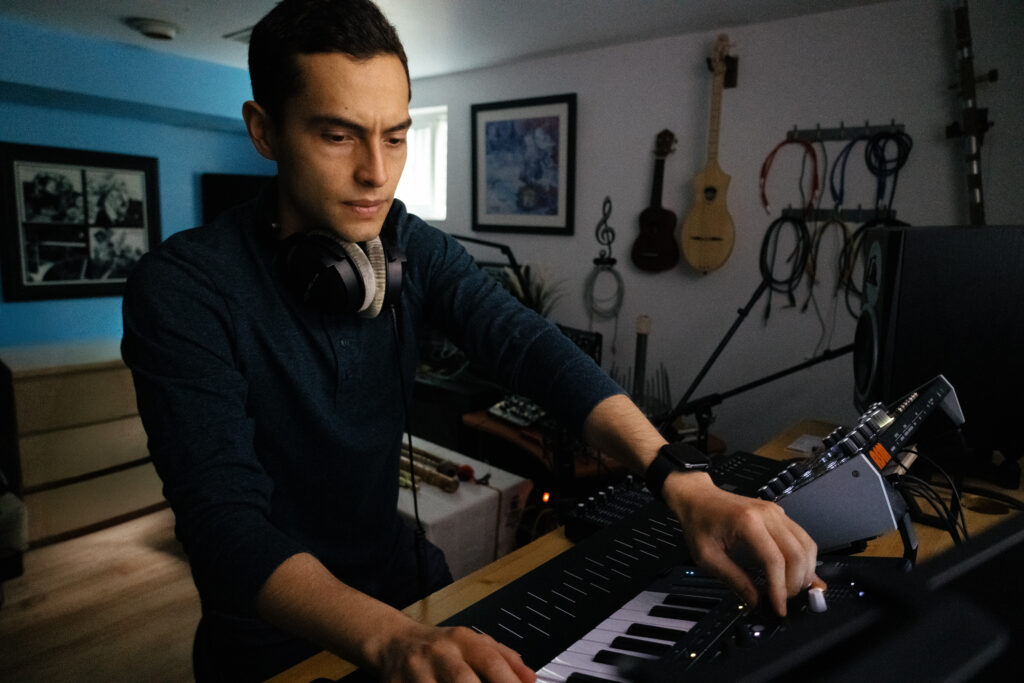
Andrés Galindo Arteaga. Photo by Valentina Caballero.
“The relationship that I had with that instrument helped me understand what articulation and emotional phrasing I could extract from it,” he said. “It also gave me a lot of appreciation of the folkloric traditional instruments – specifically to the Andean region – when I was in Colombia.”
Even though Galindo Arteaga didn’t dabble in scoring until he arrived in Canada, his father made sure that his son was well-versed in cinema.
“Every single weekend he’d bring me a DVD, whether it was something from Spanish director Alex de la Iglesia (Common Wealth, The Day of The Beast) or a German film from Chris Kraus (Four Minutes). He really got me into that cinephile headspace.”
Galindo Arteaga says that, aside from dissecting classical works and perfecting the technical aspects of music production and immersing himself in electro synthesis, he also studied the electronic works of the late Japanese composer Ryuichi Sakamoto and German contemporary electronic music figure Alva Noto. He also joined the Screen Composers Guild of Canada (SCGC) and experienced he SOCAN Labs Scoring Retreat “to understand the profession better and observe the community and the business of the collaborative process.”
The process of scoring is reactionary to the material provided and involves collaborating with a film or TV director and/or producer—professionals who don’t necessarily speak in musical terms.
“Starting at a point that embodies the core emotional meaning of a story is one of the most important things about the process of working with a composer—something that the filmmaker needs to think about first,” says Galindo Arteaga.
“My role is to dissect what they actually mean when they’re reacting with the film.”
There is also the complex challenge of injecting emotional nuance without compromising the viewer’s screen experience.
“Scoring delves into storylines and subtext,” Galindo Arteaga notes. “It’s more intricate when you’re dancing with all those elements rather than just being at the forefront with a concise idea of what the piece is or the concept is about. Sometimes it’s about adding and sometimes it’s about subtracting and how prominent or subtle those dynamics can work with the storyline.”
Some advice from Galindo Arteaga? “A good thing to keep in mind as a composer is that you’re really working with emotional subjects without overwhelming the overall experience because it’s a whole package that you’re getting as the audience. It always must serve the director’s vision.”
As his 2026 output can attest, he’s often scoring or providing the cues for several projects at once. How does he handle the workflow?
“I have to juggle quite a bit because right now, I’m doing a series, Two Brothers, Season 3, that will be premiering in OutTV by September,” he says. “And now I’m starting another feature film that will be released later this year. So, there’s overlapping almost all the time.”
However, he’s not afraid to outsource when things get a little too wacky: he brought on Braden Koksal, an emerging composer, to help with Butter Bandits. “At the time, I was juggling writing for two other feature films, so that’s why I had Braden co-composing and doing additional music as well as some other colleagues of mine. I also bring extra musicians to my studio when I need them.”
As far as the future is concerned, Galindo Arteaga does have one item on his bucket list. “I’d love to score a full-on series for a major streamer.”