In Tadoussac, songs spill out beyond the music venues. They make their way to the waterfront, beneath the skeleton of a whale at the Marine Mammal Interpretation Centre, into cafés, onto trails, and even into conversations that carry on late into the night. Music becomes the town, and the town becomes music. For Alphonse Bisaillon, whose album t.o.m. ou la trajectoire des perséides was released this past February, the festival may be the best place to see what songs become once they no longer belong only to him.
“It’s my favourite festival,” he says without hesitation. He loves its human scale, its rhythm, and the fact that people don’t come here to create content for Instagram or TikTok. “It’s a festival you go to because you genuinely want to listen to the artists who are there.” Far from major gatherings dominated by a handful of headliners, Tadoussac cultivates proximity. “There’s an active serenity here,” he says. It’s an expression that could just as easily describe the way he creates.
Originally from Saint-Hyacinthe and having studied both music and literature, Alphonse Bisaillon has emerged in recent years as one of the most distinctive voices on Québec’s new music scene. After releasing his self-titled debut album in 2022, he spent four years writing t.o.m., a project that questions male role models and the contradictions of an era marked by violence.
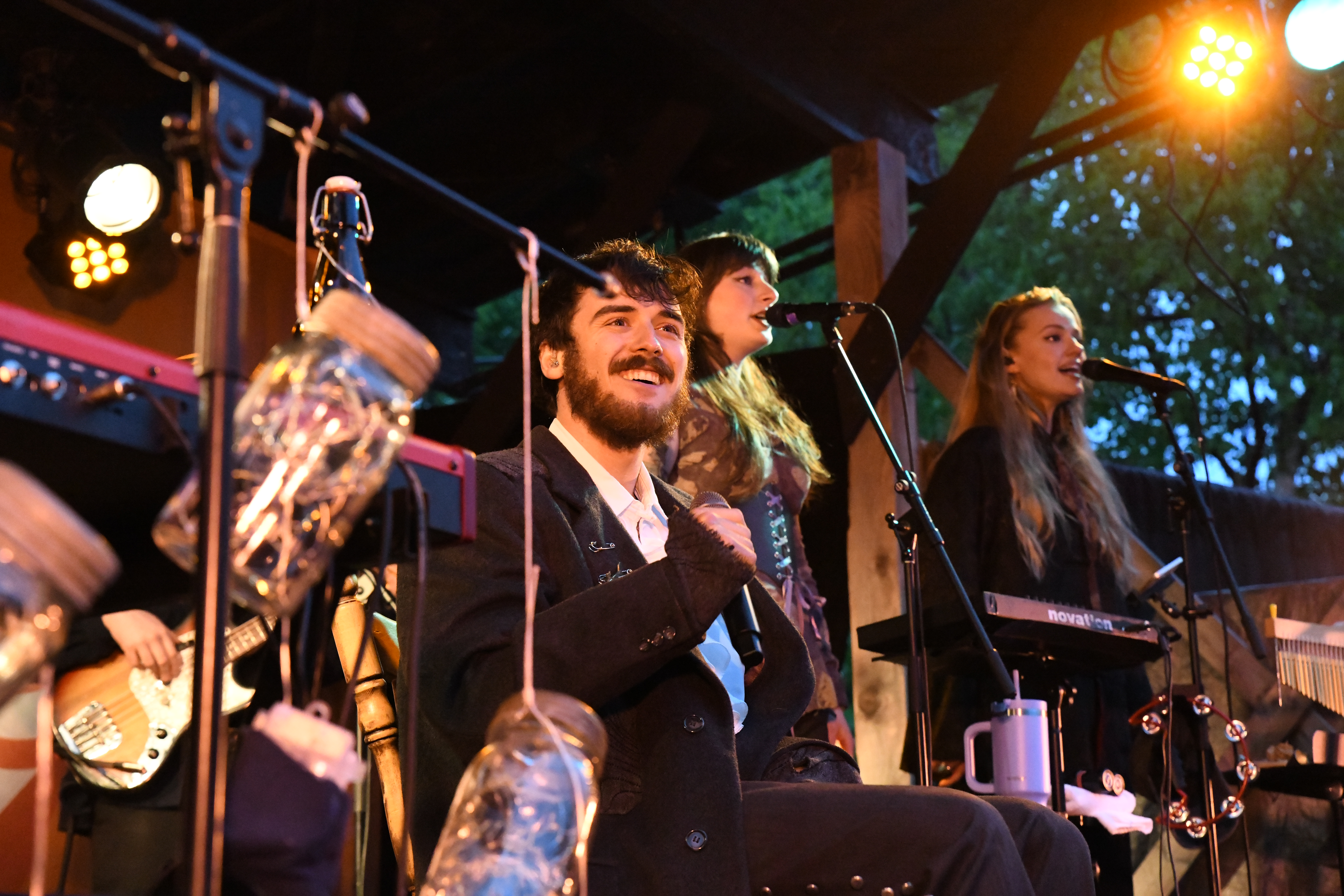
Alphonse Bisaillon in. Tadoussac (Photo by Élise Jetté)
The album was born in a setting far removed from the Tadoussac fjord. For many long months, the singer-songwriter remained shut away in his basement, absorbed by a project that had become almost all-consuming. The writing drew on the rise of polarizing discourse and other questions that haunt him. “My album is a reconciliation,” he explains today. “It’s about learning to love the men in my life, too. And to love myself as a man.” While t.o.m. examines masculinity, it consciously avoids pitting men against women. “Cruelty is human, not masculine,” he insists. “I think we need to make peace with human violence.”
Have the Courage to Face Criticism
This deeply personal record came together in a surprisingly collective way. As the songs took shape, they passed through the hands of friends, collaborators, musicians, and poets. Alphonse even organized listening sessions at home, where his friends and family members would react to each new version. “I would sing them one line at a time. One punchline at a time. Then I’d say, ‘This part isn’t working. Do we keep it or not?’ People would vote,” he says with a laugh. “There was never a moment when I was making the decisions alone.” After associating writing with solitude, he realized that an outside perspective could sharpen his intuition without distorting it.
Onstage, he envisions a show that gives the songs new breathing room. Working with stage director Nathalie Séguin and his performance coach, Marie-Claire Séguin—of legendary duo Les Séguin, with her brother Richard—Alphonse Bisaillon completely rethinks the narrative arc. The song order changes. The musicians constantly switch instruments. The backing vocalists become percussionists or pianists before returning to vocals. At certain moments, the whole band gathers around a single microphone.
Even the set design reflects that desire to transcend boundaries. Inspired by the aesthetics of poor theatre, it relies on just a few simple objects: a chair, a coat rack, glowing jars filled with artificial fireflies, and a cabin built onstage. “I love the creativity that comes with limited means,” he explains. “We wanted sets that had a bit of a feel.” For him, that freedom also grew out of the trust his team placed in him. “I had a vision. I would say, ‘I’d like it to be this.’ And people were like, ‘Well, OK.’” The experience, he says, taught him “that you have to follow your instincts.”
The Summer’s Phenom on the Festival Circuit
With the album’s release came another surprise: discovering how audiences were making his songs their own. “What surprised me most was how much what I wanted to achieve… is exactly what’s happening.” Unlike his first album, where audience reactions sometimes revealed the meaning of his own lyrics to him, t.o.m. confirms that he managed to convey exactly what he had hoped to.
One man, for example, told him he wished he had heard these reflections on masculinity as a teenager. A Vietnamese family said they recognized themselves in monsieur Quan. Others have written to share what some of the songs stirred in them. “What I’d love most is for people to be inspired by it,” he says. “When someone creates choreography to one of my songs or sends me a poem, I feel like it matters because it creates movement.”
And movement was very much part of Alphonse Bisaillon’s performance in Tadoussac: a sea of people packed in front of the stage, chanting his complex lyrics by heart, in the rain.
At another concert in Lavaltrie, young people from different regions of Québec told him they had met at one of his shows a few years earlier, and that a lasting friendship was born. “I feel like something is happening. That it brings people together and makes them want to create,” he says.
For a long time, his life was wholly invested in writing t.o.m. He confides that he almost went through a period of mourning once the creation was done. “I missed it,” he admits. The project that had filled his days no longer belonged only to him. Today, with shows taking him across Québec and France, he is finding out another way of inhabiting his songs. “Now, getting in front of people is kind of my vacation,” he says with a smile.
In Tadoussac, where artists cross paths with their audiences as naturally as they do with one another, that line takes on its full meaning. The songs have left the basement where they were born. Alphonse Bisaillon is no longer simply presenting them: he’s watching them follow their own path.
Alphonse Bisaillon Tour of Festivals
July 17—FEQ, Québec City
July 25— Le Festif!, Baie-Saint-Paul
August 6 — Festival Colline, Lac-Mégantic
August 14 — Festival à deux têtes, Sainte-Brigitte-de-Laval
August 22 — Festival Motel Calix, Calixa-Lavallée