When future historians try to pinpoint the exact moment when Angine de Poitrine went from underground cult to global sensation, they will, without a shadow of a doubt, unanimously agree on Saturday, February 7, 2026.
That day, their performance – captured by Seattle radio station KEXP during the Transmusicales de Rennes Festival – spread like wildfire across the Internet. The polka-dot-clad duo from Saguenay, Québec – playing strange, hybrid instruments to create utterly offbeat music – struck a different chord.
Boosted by the algorithms of TikTok, Twitter, Instagram, and YouTube, the duo’s intimate concert sparked a mix of fascination and disbelief, racking up views now counted in the millions – 2.6 million, to be precise.
“I remember the exact moment when everything changed,” says Khn, the band’s stringman (guitar and bass). “I was having a smoke under my range hood, replying to every comment online like I’d been doing since the beginning. But that day it started snowballing at breakneck speed. That’s when I realized that even if I did that full-time, there was no way I could keep up on my own.”
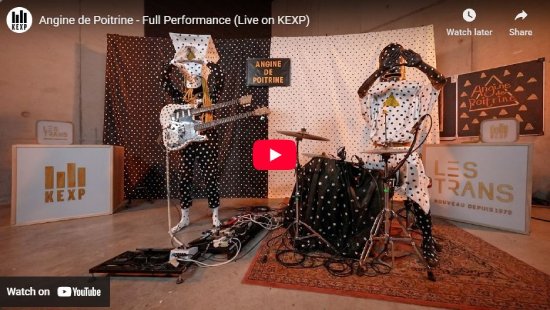
Access the performance video of Angine de Poitrine
In Brazil, Japan, France, Germany, Portugal, and around the world, Angine de Poitrine’s microtonal wizardry slid into listeners’ minds like an irresistible earworm. “Microtonal,” you might ask? It’s a technique used by Khn that’s common in Indian musical traditions but quite rare in the Western system, where quarter-tones come into play. The result is a bold, radical offering that blends the rigour of math-rock, the delirium of psychedelia, the energy of garage-rock, and the groove of funk. Given the already impressive number of very serious analyses their compositions have been subjected to online, it’s safe to say that Angine de Poitrine is the kind of band that emerges only once a generation, if that. One question remains: where does this passion for microtonality come from?
“I already knew a little about it, but it really blew my mind when Khn showed up at my place holding his microtonal guitar,” recalls Klek, the band’s drummer. The unusual instrument – which helped make the band’s reputation, and inspired hundreds of guitarists to explore quarter tones themselves – was built by a luthier from their region. Armed with a two-neck guitar, each neck fitted with twice as many frets as a traditional guitar, and a ginormous array of effects pedals – including a looper that allows him to record and layer bass and guitar loops – Khn has built the sonic architecture behind Angine de Poitrine’s unique sound, one that feels vaguely familiar yet almost completely disorienting.
“Obviously, we didn’t invent microtonal music, we simply followed a path that hundreds of trailblazers cleared before us,” says Khn. “It’s the embodiment of a passion I’ve always felt for that kind of sound. I was obsessed with the idea of digging up the most obscure and strange stuff I could find, and that led me to explore Turkish music from the ’70s. What I discovered during that exploration was a kind of psychedelic rock that balanced tradition and modernity; it was an entire musical universe unto itself.”
Among Angine de Poitrine’s new admirers are younger listeners introduced to microtonal music by bands like King Gizzard and the Lizard Wizard, as well as a few older Gen Xers and younger baby boomers, who grew up on 1970s progressive rock and see the band as carrying forward the legacy of King Crimson. “We did listen to a f*ck-ton of old prog!” says Khn. “There’s an undeniable influence from that genre, whether it’s in how we construct our melodies, how we play with complex meters, or in the idea of throwing in curveballs like rhythmic breaks. It’s definitely part of our musical DNA, but I feel we brought a much more pop-oriented approach to it.”
“Right now, we’re living the dream” – Khn
While these strange sounds may strike the uninitiated as dissonant, even abrasive, the pieces on Vol. 1, released in 2024, and Vol. 2, due out on April 3, 2026, won listeners over with an irresistible groove that unfolds in an almost fractal way, through repetitive motifs, punctuated by subtle variations, producing a trance-like effect. “Our challenge in the studio is to recreate the live atmosphere, not the other way around,” says Khn. “Using loops comes with its own rigour, but it’s also very freeing, and that’s why each of our shows is completely different.”
Like Daft Punk or the Residents, Angine de Poitrine has chosen anonymity, not as a gimmick, but as a way to focus entirely on the music. At first, it was simply an outlet for the two musicians, who’d been playing together for several years in various bands, to explore other musical avenues with complete freedom. But today, it seems impossible to separate the group from its uniforms. “The costumes are an integral part of Angine de Poitrine’s artistic offering,” Khn explains. “If we were ever to abandon them, it would be because we’d moved on to another project, with a different name and a different identity.”
Do they ever regret having quite literally locked themselves inside their papier-mâché uniforms? “Let’s just say it’s a sensory experience like no other,” says Klek. “I’m the one whose vision is the least obstructed by my costume, and all I can see is one of my toms and my crash cymbal – so imagine what it’s like for Khn! But the real challenge is the heat, and depending on the venue, I can come close to passing out. By the end of the show, it’s about 50 degrees Celsius inside my mask!”
“What I like is the ritual,” says Khn. “The hour we spend getting ready and doing our makeup before each concert puts us in the right headspace to totally focus on our performance.”
Angine de Poitrine’s may drop their masks one day, but it’s unlikely to happen anytime soon, judging by the enthusiasm they’ve generated among music lovers around the world. In fact, the group quickly evolved from a small side project into a full-fledged career for the two musicians. “For now, we’ve set aside the idea of playing in four or five different bands,” Khn confirms. “We might lose a bit of sleep over the next year or so, but we’re not complaining. Right now, we’re living the dream: making a living while travelling to places we never imagined we’d set foot in, all while having a blast. I mean, what more could we ask for?”