Of all the creative approaches taken by songwriters, Hiroki Tanaka’s has got to be unique: turning the Christian hymns in his Japanese-Canadian grandparents’ hymnbook into an ambitious exploration of faith, culture and history while integrating a breathtaking number of different musical and vocal styles.
Isan (“inheritance”) is the second solo album from Tanaka, the former guitarist for Yamantaka Sonic Titan, and it incorporates some of that group’s exuberance and knack for genre-jumping. The album’s 11 tracks feature delicate pop melodies, screaming guitar solos, soaring and whispering vocals, inflections of synth pop, alt rock, and ‘70s prog rock keyboard solos, and even operatic vocals from guest singer Teiya Kasahara on the closer, “Golden House.” Isan is both dazzling in its scope and brilliant in its execution but, perhaps because it doesn’t fit into modern musical formats, it’s not getting a lot of attention.
“I get that it’s not an easy record to categorize, but that was my goal, to create something broad and varied,” he says. “All these different genres are things I enjoy and consume on a regular basis, and this is my take on them. I deliberately tried to create many layers in both the songwriting and the production process.”
Isan’s genesis dates back to Tanaka’s 2020 solo debut, Kaigo Kioku Kyoko, which he calls his “caregiving album” because it was about archiving memories and recordings of his grandmother and uncle toward the end of their lives. “They were both dying and the house I was raised in was going to be sold, and I wanted to preserve what I could.” Inspiration came when he found an old hymnbook, a relic of his Japanese-Canadian family’s controversial embrace of Christianity.
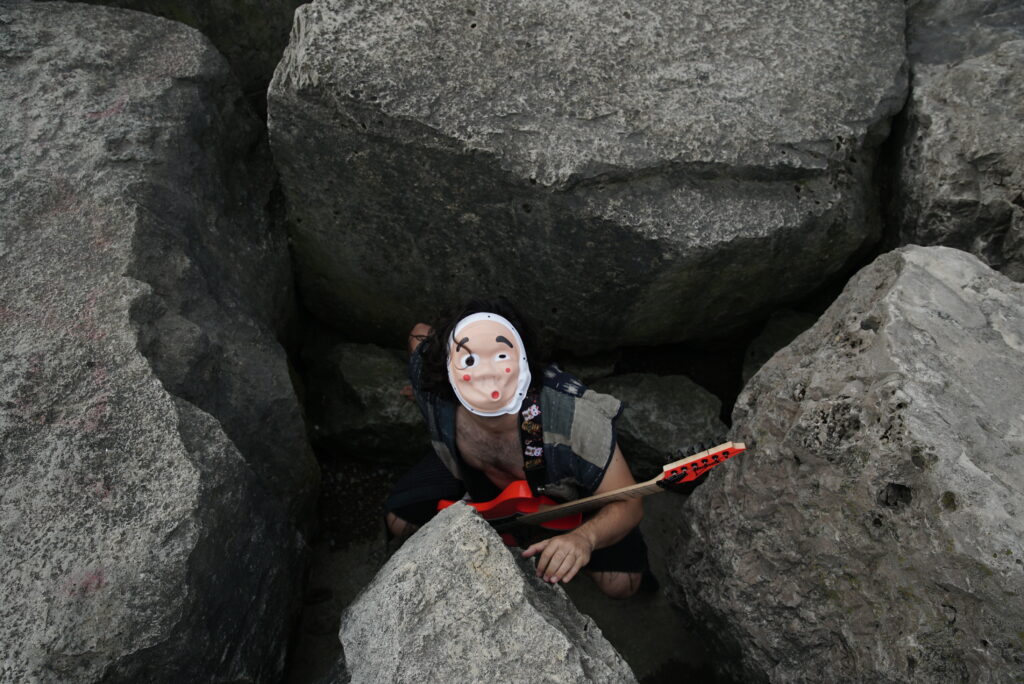
Hiroki Tanaka. Photo by Maya Bankovic
“I rifled through it and saw that they were hymns written by Japanese people, and I was fascinated,” he says. “I sat down at the piano and played them and I was like, ‘Wow, these are Japanese melodies but used toward the worship of Christianity.’ I wrote one song for Kaigo Kioku Kyoko using a hymn from the book, and that started the concept of taking the harmonies and key signatures and melodies of hymns and using them in my own songwriting.”
Interested in the influence of Asian musical aesthetics on Western music, Christianity’s checkered reception in Japan and his own family’s Christian missionary work, Tanaka started exploring the history of the hymns and their composers. “Part of it was to bring attention to these hymns out of my own academic curiosity,” he says. “I’m not religious, but I love the hymnal form: it’s really simple, harmonically beautiful and obviously very singable, and that appeals to me. I started writing, taking lyrics and themes and approaching the religious symbolism from my own critical lens, and exploring my Christian upbringing and how that affected me.”
The writing process was exploratory, he says. “I would take the melody and play around with the hymns for a while, and then I’d sort of get hooked on this one aspect and be mulling over that, and eventually something would come out of it.”
The lyrics address themes like the meaning of home, war, patriotism and fundamentalism, and reference biblical stories like Abraham’s sacrifice of Isaac, which Tanaka explores in the achingly lovely “Unbinding,” and the problematic concept of the chosen people in the furiously rocking “Chosen.” “I hate the whole idea [of a chosen people],” he explains, “so it’s a critique of that in the alt rock flavour that I’ve always enjoyed.”
A songwriting workshop Tanaka took with Phil Elverum of The Microphones was another important step, leading to the integration of the hymn “Ikoi,” which opens the album, with the new song “Yamato.” Including them both illustrates their intertextual relationship, he says. “You can see how the melody ended up being used again, and how the rhythmical gallop of ‘Ikoi’ reappears in ‘Yamato.’”
Tanaka tapped his Yamantaka Sonic Titan bandmate Brendan Swanson (“a Swiss army knife” of collaborators) to produce Isan, and Kohen Hammond to record and mix it. Then he gathered a band of disparate Japanese-Canadian musicians, including Dylan Matsuda, Hiroyuki Tanaka, Brian Kobayakwa, Annie Sumi and the Kronos Quartet’s Paul Wiancko. “I’d met Paul in Banff, where I finished my songwriting, and later I asked him to put strings on ‘Golden House’ and he amazingly obliged. There are moments of almost cartoonish glee that he brings in, and some really powerful emotive moments. It’s the perfect finish, I think.”
Apart from including taiko drums on a couple of tracks, Tanaka used Western instrumentation on Isan. “I wasn’t raised on traditional Japanese music, and I don’t really consider that part of my musical heritage,” he says.
“The traditional rock band format is the music I love and have played for most of my life, and its vocabulary and genres are what I’m familiar and comfortable with. I was happy to create the music I wanted while exploring my Japanese heritage in the way I wanted.”