Caity Gyorgy with Strings, Arranged and Conducted by Mark Limacher almost didn’t see the light of day. But a wedding cancellation, lack of funding, and an estrangement between Gyorgy and pianist and arranger Mark Limacher were obstacles to get the project across the finish line.
But Gyorgy (pronounced “George”), a three-time Juno Award winner, is nothing if not resilient.
“We were both going through a lot and I thought, ‘Well, I don’t know if this is actually going to happen.’”
“[This album] was something that I really wanted to make happen because I believe strongly in the music we had written together,” Gyorgy tells Words and Music from a New York City hotel room with Limacher.
Gyorgy and Limacher first wrote together in 2023 at the Yukon Summer Music Camp in Whitehorse, where Gyorgy serves as a faculty vocal jazz instructor. Limacher, based in Calgary, was also part of the faculty. The duo had released a Jerome Kern tribute album, You’re Alike You Two, earlier that summer, but Gyorgy was hoping to evolve their relationship by incorporating songwriting.
“Mark had made these beautiful arrangements for three of my songs, arranged for 15-piece strings plus clarinet,” she recalled. “I adored these arrangements so much I started writing a sort of jazz standard called ‘That Doesn’t Matter.’”
“I’d written the lyrics, which were basically about how we were very different, but at the root of it, both very similar in terms of passions and morals. I brought the “A” sections with me when we were teaching and giving performances as part of Jazz Yukon. During one of our lunch breaks, I said, “I’ve started writing this song. It’s about how much I love working with you. I’m very nervous to show it to you, but I can’t figure out a bridge, and I was hoping maybe we could do this together.”
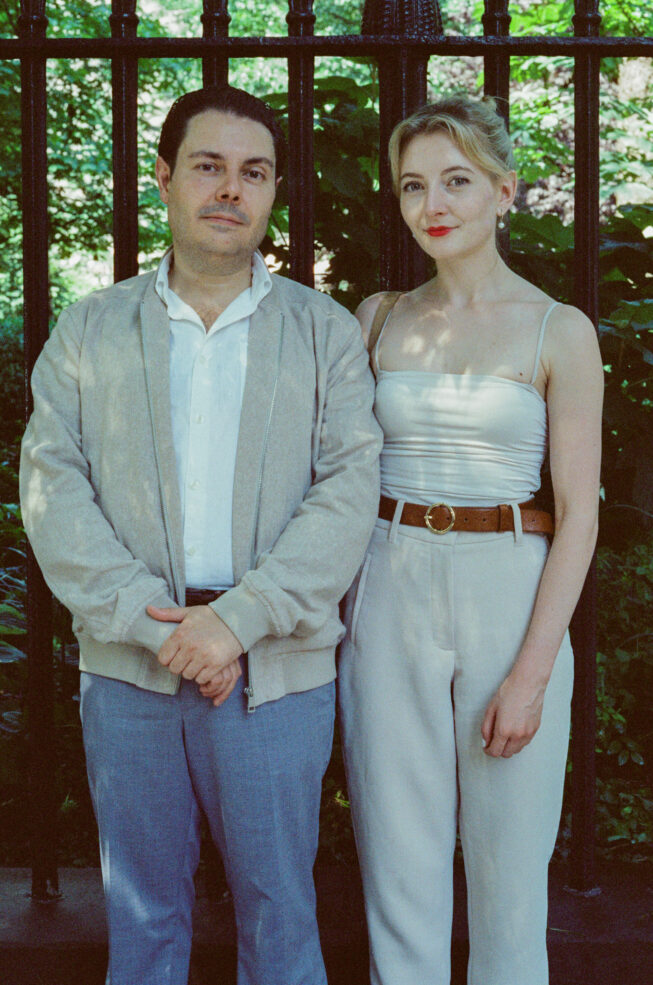
Mark Limacher and Caity Gyorgy. Photo by June Cavlan.
Gyorgy says the duo completed the bridge and then wrote four more songs together at the camp “because it was just very easy.”
“I’ve written with other people before but never as seamless as with Mark,” Gyorgy explains, adding that the creative partners wrote another song that made the orchestral album, “Train Wrecked Dining Car,” before leaving the camp.
Limacher echoes Gyorgy’s sentiment about their chemistry, both as writing partners and musicians.
“We have extraordinarily similar musical instincts,” he says. “That’s really evident when we play together. There are a lot of moments where we will play some little decorative thing in unison from improvising. It’s always kind of spooky but it happens so often.”
The duo recorded another project, the Frank Loesser-inspired Asking for Trouble, before what would be their first orchestral project, Caity Gyorgy With Strings, Arranged and Conducted by Mark Limacher.
“I wanted to do this orchestra album as soon as we did our first small orchestra recording,” Gyorgy recalls. “I remember being up in the booth and planning a budget with the engineer on how we could do this on an even larger scale, [including] how many days we might need in the studio.”
Drama rocked the following two years: Gyorgy called off her wedding and ended an eight-and-a-half-year relationship. However, as a writer inspired by the Great American Songbook, she says she was thankful for the ability to translate her emotions into song.
“Up until that point, I think I was a pretty ignorant person in their mid-twenties who thought they had everything under control,” Gyorgy says. “Obviously, as each day goes by, I realized that is so far from the truth. It was nice to get to experience the emotions that I’ve been hearing all of my idols sing about, like Frank Sinatra on Only the Lonely, where he’s got all these sorts of depressing songs. I’d never really related to those before and then, suddenly, that was all I was listening to. The idea of making it an original album with strings seemed like it had to happen.”
It doesn’t seem like it in the moment but it takes time for art to unfold how it’s supposed to. For Gyorgy and Limacher, both going through big life changes, and a literal and emotional distance between them (one in Calgary, the other in Montréal), including a sort of estrangement, along with a series of grant rejections and approvals, this project seemed stuck elsewhere.
Fate, however, had another idea. Gyorgy received a surprise last-minute offer to do shows with the UMO Helsinki Jazz Orchestra in Finland.
She reached out to Limacher immediately. “I commissioned Mark months in advance to do these arrangements for me. Helsinki asked if I had any charts. I hadn’t really talked to Mark much then, but I phoned him up and I said, ’I’ve been offered this thing. Is there any way that you can get me these charts two weeks earlier?”
Gyorgy even flew Limacher out to Helsinki on her own dime so he could experience it as interpreted by the local jazz band.
“The arrangements were wonderful,” Gyorgy recalls. Limacher texted her how good it sounded, which, as she recalls, “restarted this whole orchestra thing.”
Limacher says the 35-piece orchestra sessions for their Juno-nominated Caity Gyorgy With Strings, Arranged and Conducted by Mark Limacher, consisted of five three-hour calls estimated to cost a little over $10,000 each, but were extremely efficient.
Moving ahead as creative partners after this release, Gyorgy and Limacher are planning to release a third duo album in August—a salute to Cole Porter—with the hope of creating a niche for themselves in the realm of orchestral albums.
“Everything that we make goes back to recording and writing more,” says Gyorgy. “Mark and I have talked so much about how the people that we loved to listen to—Eydie Gormé or Frank Sinatra or Oscar Peterson—how their discographies are so fascinating in that they released multiple albums a year, with orchestras, in the ’50s and ’60s.
“That’s not exactly possible these days, as the industry isn’t the same as it was, and we’re both independent artists funding it. We’ve created this exciting Pops Orchestra recording scene in Calgary at the National Music Centre, and it’s really fun to have all these wonderful musicians involved in this. And they keep wanting to do it again and they ask to be a part of it, which means we’re doing something right. These musicians are picky, so if we’ve won them over—at least with the catering—then that’s a good thing.”