If you listen to Indigenous music in Canada, and you don’t recognize the name Tristan Grant now, you soon will – and you won’t forget it. Perhaps you’ve already heard of him under his stage name, Wolf Castle, a Mi’kmaw rapper and producer from Pabineau First Nation, New Brunswick. With more than 10 years in the music business under his belt, Grant has launched Castle Records, the first Indigenous-led record label on the East coast of Canada.
Over the phone on a sunny Maritime morning, Grant explains why he did so. “As indigenous artists are getting more attention on them, [it’s essential] that our art is protected, that it’s being put out in the world by other indigenous music industry people – there’s not a lot of us out there.” He elaborates, adding, “My label plans to be completely transparent about what we do, why we do it, how publishing works, because in my experience as an independent artist, that’s not stuff that anybody really tells you. You have to figure it out as you go, and sometimes you miss those things.”
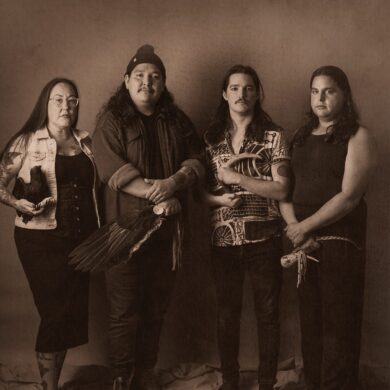
The Hello Crows
To that end, Castle Records has signed its first artist, The Hello Crows, who first came together as part of a Wabanaki songwriters’ circle on the National Day for Truth and Reconciliation in 2022. Their self-titled debut album on Castle is being released on the group’s third anniversary, Truth and Reconciliation Day, 2025 (Sept. 30th).
“They were the perfect band to start this whole journey with,” says Grant, “because they’re an emerging band, they were getting a lot of local buzz, and I liked that they were already a self-driving machine. They’d be making a record whether or not I was involved.”
Castle Records certainly isn’t alone as an Indigenous-owned and operated music label in Canada, what with Musique Nomade in Québec, Ishkode and Red Music Rising in Ontario, Land Back Records in B.C., and Hitmakerz in Nunavut. “I started seeing more indigenous labels across Canada that exist already, and have been paying attention to how they operate,” says Grant, though he thinks he can bring something a bit different to the table.
“I’ve talked to other people on the East coast about the general day-to-day stuff, like Forward Music Group [the label to which Wolf Castle is signed]. These are all independent labels that don’t have any sort of major label as a parent company. It’s very grassroots, and [they’ve] been operating that way for many years. They’ve been really helpful.
“I think that a lot of people outside the Indigenous communities don’t always know how to promote or market Indigenous artists. From my perspective, there are certainly markets, and specific places, that the average record exec or music industry person wouldn’t necessarily know how to tackle, or enter that space – one of those being Powwows across North America. It’s something we need to integrate a lot more.”
He also turned to the Indigenous Music Office for advice. “I let them know way ahead of time what my plans were before I announced it, and talked to them about how we could work together in the future,” says Grant. “I really love organizations like that, especially the Indigenous Music Office, because I see what they’re trying to do. A lot of us, in the music industry in general, rely on grants and funding, through FACTOR or provincial funding bodies. The Indigenous Music Office is trying, amongst many other things, to be another potential funding source for projects. I think it’s awesome to see that I’m really not the only person trying to do this.”
Considering the ambitious plans he has for the new label, will Wolf Castle be put on the back burner? “Not at all,” says Grant. “I’m continuing to do the music industry thing, and… I’m very much going to continue do the whole Wolf Castle thing. But when it comes to releasing [Wolf Castle] records, I’m not going, for now, to put them out on Castle Records. I’m going to stay with Forward Music Group, the label I signed with…
“I’ve had a pretty good success rate with funding, and things like that, as an independent artist. I sailed my own ship for years and years. Also, I have access, within our label, to people who we can talk to, and hire, for grant writing and editing. We have a good community of industry folks on the East coast that are just helping everybody out.”
Always Use Protection
A word that keeps coming up in Grant’s conversation is “protection.” As he explains, “The music industry is very difficult to navigate. There are a lot of revenue streams and business things that are not really easily known or understood… I’ve talked to people in the industry that sign record label deals when they don’t know what they are, what the clauses are, or what the parameters of the deal are. They don’t know how to track down all of their royalties and publishing. There’s a lot of money left on the table that artists don’t know about. It would be easy for a label to sign you, give you a weird publishing split, and take a lot of the revenue away.
“Also, it can be very lonely and isolating to be a musician when you feel that you don’t have some support. I just think that I need protect artists from being exploited, or not taught this information. It’s a great privilege for a band to trust me with their music, so it motivates me to work harder, and learn more about the business as well…
“There’s a problem happening in our communities right now, where we’ll be hired as the ‘token Indian’ at a music festival, or for conferences. Another new problem is what we call the ‘pretendian’ issue, where there’s people who actually pretend they’re Indigenous, and take funding opportunities away. I’m here to help with that.”