“What are you sayin’?” asks Lance Sampson, the man behind the musical project known as Aquakultre, greeting me at the beginning of our conversation. In the daily life of Sampson – for whom the phrase was a daily occurrence growing up in Uniacke Square, a Halifax neighbourhood with strong ties to Black Nova Scotian history – the question is multi-layered, at once externally inquisitive and internally reflective.
It’s also the title of the opening song of Aquakultre’s latest album 1783. Time-stamped with the date that Black Loyalists – including Sampson’s direct ancestors – first arrived in Nova Scotia from the U.S., it’s a musically compelling, multi-generational exploration of his family roots. The sumptuously soulful “What Are You Sayin’?” sets the tone for the LP, inspired by Sampson’s experiences as a youth outreach worker connecting with younger people.
“1783, the album, is a result of these inter-generational conversations, travelling across Nova Scotia,” says Sampson. “All of those conversations inspired a lot of the writing.”
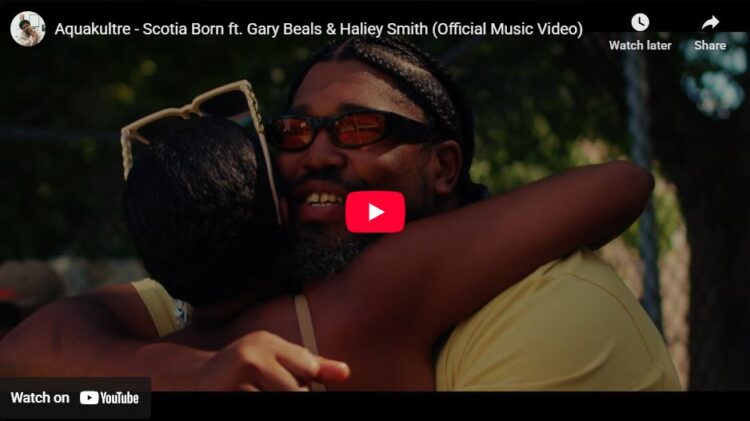
Select the image to access the video of Aquakultre’s “Scotia Born,” featuring Gary Beals & Haliey Smith
It didn’t start out as a musical project. Sampson initially wanted to be able to answer any potential questions he might be asked by his children about Black Nova Scotian history, and his family’s place within it. So, he decided to embark on a road trip to collect information from people living in East Preston, North Preston, and other Black communities in Nova Scotia, as well as Black Nova Scotian history experts like Sylvia Hamilton and David Woods.
“I just wanted to see if there was anybody of the older generation that I could talk to, maybe just ask them certain questions about family members that I’ve tracked down in my ancestry,” says Sampson. “So, it started with that, and through that, a lot of these themes were coming into play.” From those travels, Aquakultre was involved in several projects, including GeneratioNS: Black Memories of Nova Scotia, a TV show he created and wrote, featuring conversations about Black Nova Scotian history.
Invariably, on the long drives he would take to meet people, Sampson would get ideas for songs, like “Bags Packed”; he was convinced that a musical element of his new learnings had to emerge. Consequently, Sampson set about staking out the parameters of 1783’s creative process.
In the past Aquakultre has worked extensively with renowned Nova Scotia hip-hop producer Uncle Fester, in a process where the two exchanged beats and musical ideas in quick succession. The duo also worked together on Aquakultre’s 2022 album Don’t Trip. But for 1783, Aquakultre took a different approach, working with Halifax singer-songwriter/producer Erin Costelo. The two talked through the creative process extensively, several months before ever setting foot in a studio. They listened to music and figured out what they wanted the project to achieve, using the knowledge and research Sampson had collected to ask pertinent questions.
“What kind of canvas are we painting with this?” says Sampson. “It was a deeper process, of me actually having to unpack a lot of where this stuff was coming from. And she was able to be, like, ‘This is where we want to take folks, and this is the journey we want to take folks on, not just with the storytelling, but [also] musically.”
“This is a life’s work, and it continues”
The process is borne out by the rich, layered production and thoughtful sequencing of 1783, which is grounded in a warm sonic intimacy, and Sampson’s unerringly heartfelt voice. Songs like “The Avenue,” excavating memories of the Black community on Crichton Avenue in Dartmouth, NS; “Make That Change” featuring Measha Brueggergosman-Lee’s nod to legendary Halifax contralto Portia White; and the gospel stomp of “Matriarchs,” all convey the layers of history, of largely untold narratives, which unravel over the course of the songs.
For example, “Holy” is preceded by an interlude featuring an army sergeant passing on a letter to a solder, as it’s specifically written about a soldier who served in the 2nd Construction Battalion. Formed in 1916 in Nova Scotia, it was the largest Black unit in the first World War, in which Sampson’s great-great grandfather Daniel Perry Sampson served. Hels also the subject of the comparatively harrowing “Gallows,” which immediately follows “Holy.”
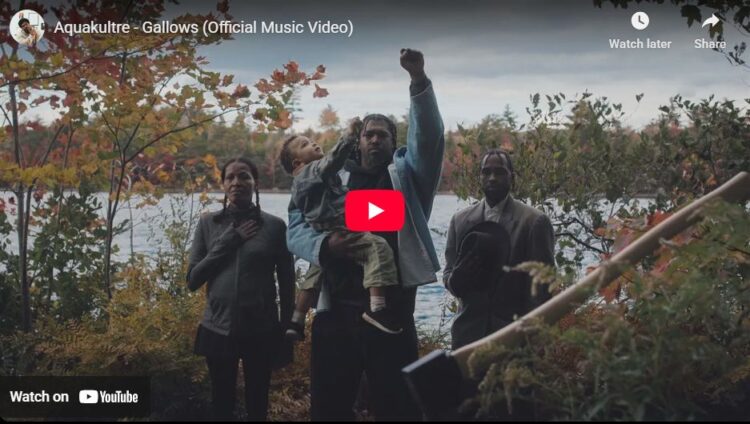
Select the image to access the video of Aquakultre’s “Gallows”
As well as being a veteran, the elder Sampson was the last person to be executed in the Halifax courthouse, in 1935. Daniel Perry Sampson was accused of killing two young white boys in Halifax, but a myriad of inconsistent evidence including a dubious confession, suggest he was unjustly executed. It was a story retold to Sampson by his grandmother, and manifests itself in the intensely performed “Gallows.” The song is written from Daniel Perry’s perspective in the minutes leading up to his execution, and is particularly challenging for Sampson to perform.
“Anytime I perform it, It’s a lot of energy. It takes out a lot,” says Sampson, who originally workshopped the song as a demo with Halifax’s 2b theatre company. “Obviously, I’m following my grandmother’s wishes with this whole process. And she made sure to tell me that the truth needs to come out with this. Every time I perform it, it still rocks me.”
The issue is still very much alive. Sampson and his family have been making progress in recent years, working with a lawyer, and with the pertinent authorities to exonerate Daniel P Sampson’s name. The case is just one example of the inter-generational dialogue that 1783 aims to foster, manifesting and immersing itself in the past, the present day, and the future.
“1783 doesn’t just start with it being released February 6, 2026” says Sampson. “This is a movement that I’m continuing to try to establish [over] the next four or five years, and maybe [for] the next generation. I want to make sure that this project isn’t just a typical, regular album cycle. This is a life’s work, and it continues, and I’m just contributing to the work that needs to happen. I’m happy to be able to contribute, and open up the conversation.”