In February of 2026, Toronto’s Justin Gray became the first Canadian to not only earn a nomination in the 2026 Grammy Awards’ Best Immersive Audio Album category, but to win – for his ambitious Dolby Atmos solo debut, Immersed. And he hasn’t come down from the high yet.
“I’m trying to keep it alive as long as I can,” he laughs. He’s also up for Jazz Album of the Year – Solo, at the upcoming JUNO Awards, and is awaiting the arrival “sometime soon” of the actual Grammy trophy, with his name engraved on it.

Select the image to access a video of Justin Gray accepting his Grammy Award
Gray is a professor of audio production at his alma mater, Humber College. His credits include Olivia Rodrigo, Snoop Dogg, The Tragically Hip, Brandy, Nelly Furtado, Mother Mother, Blue Rodeo, Arkells, Jann Arden, Karan Aujla, Mae Martin, and Josh Ross.
Outside of teaching, he spent 35 days, over the course of four years, recording the 58-channel Immersed in the Humber studio, plus additional filming days for the Blu-Ray (also on Vimeo), to complete his dream project. It features 38 artists, including three dancers. “That means 35 musicians, 33 of whom live in Toronto,” Gray says with pride.
Gray is the writer, arranger, producer, recording engineer, and mixer on all eight songs, and worked with co-producer Drew Jurecka, who did some additional string arranging. “He won a Grammy with me,” says Gray. The other musicians will receive what’s known as a Grammy participation certificate.
“There’s so many people involved in the project,” says Gray. “I’m at the front of it as the bandleader, primary producer, and composer, but it really is a community of people who made the music come to life. And so, the ability to re-live that joy with them, as well as with my students – it was all recorded at Humber, where I teach – means that people can feel connected to it; and connected to what, of course, the recognition of the Grammys is, which is an opportunity for the world to see what we do. It means a lot to me, but it feels like it means a lot to the community, which I love.”
Other SOCAN members involved in writing for the album include Ed Hanley, who co-wrote “Pendulum;” Shawn Rompré, co-writer of “Tapestry;” Francois Mulder, who co-wrote the lyrics for “Illuminate”; and Suba Sankaran, who wrote the solkattu (South Indian syllables) on “Repose.”
It’s the first time an album in the Grammy’s immersive category – previously named Best Surround Sound Album – has been created in Dolby Atmos from the start, as a spatial presentation. The sound technique is also known as special audio, 3D audio, or object-based audio. As a body of work, Immersed is an encircling soundscape of jazz and world music, with countless instruments, from horns and strings to kalimba, sarod, santur, and udu.
“The simple takeaway, for me, is that space can be a part of our composition”
As a composer, Gray came into the sessions with everything mapped out. “Scores are tight, orchestrations are perfect, charts have to be perfect – because if you miss something, you lose time, and you waste everybody’s time,” he says. “With the budget and timelines, and the busy schedules of all of the people involved, it needed to work like clockwork.”
While Gray composed the songs, he left room for a lot of the natural improvisation typical of jazz and global music traditions. “That’s the beauty of the studio, to be able to be ready to obviously capture what you intended, but also, to pivot when something exciting is happening,” he says.
Obviously, unless you have access to an Atmos studio, or Gray arranges for more screenings (he toured the album in Dolby Atmos-equipped theatres), people won’t be able to enjoy Immersed as he intended it. He’s OK with that.
“I see it through two lenses,” he says. “One is as an artist… I gave myself the permission to create the art the way I wanted to create it, for the sake of the art. But rather than thinking about the limitations, I just created what was in my mind, and I found that to be very empowering.
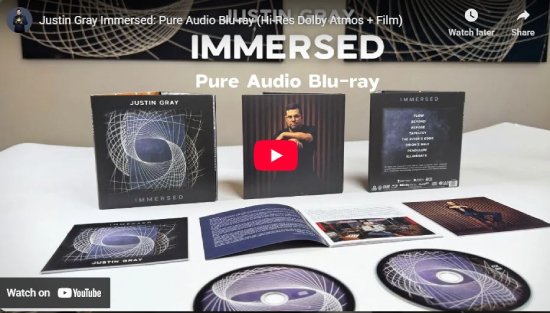
Select the image to access a video of Justin Gray discussing Immersed
“But then there’s the exact opposite, which is, as much as this is a piece of art that is infused with technology – even the award itself literally has technology in the term – music is music. So the immersive audio part is technology, but the album part is music.z
“And music, whether it comes out of one speaker, it comes out of our phone, [or] it comes out of a speaker around the corner, we’re going to be moved by it, or we’re not. I really do think that at the end of the day, melody, harmony, form, momentum, tension and release, these are all way beyond technology.
“So, the simple takeaway for me, with this particular project, is that space can be a part of our composition,” he says. “A composer can start to imagine that the idea of the parts of their composition being presented [to a listener] in front, or beside, behind, above, below, that these are all things can be realized through the technology… If [creativity] can involve space in a way that’s meaningful to a composer, amazing.”
And after tackling such a big project, what’s next for this Grammy winner? “I’m doing myself the favour to remind myself that this project took a long time, and the one that I would want to do next, or the many that I would want to do next, will also take time. And so, not feeling like something suddenly needs to be rushed because of an award, but rather just centering in on the intent,” says Gray.
“I don’t need to be the composer,” he continues. “I’m happy to be, and I will be again, but I want to find myself in that production role, helping to realize some other people’s music. Because that means that they’re going to pose a challenge that needs to get solved a different way. That’s just as exciting to me.”