This is the story of Alexandre Leclerc and Maxime Le Flaguais, two SOCAN members with a passion for history, who saved a heritage site from demolition by restoring it to its former glory.
Here are five reasons to take an interest in the revival of the cabaret at 1208 Crescent Street in Montréal.
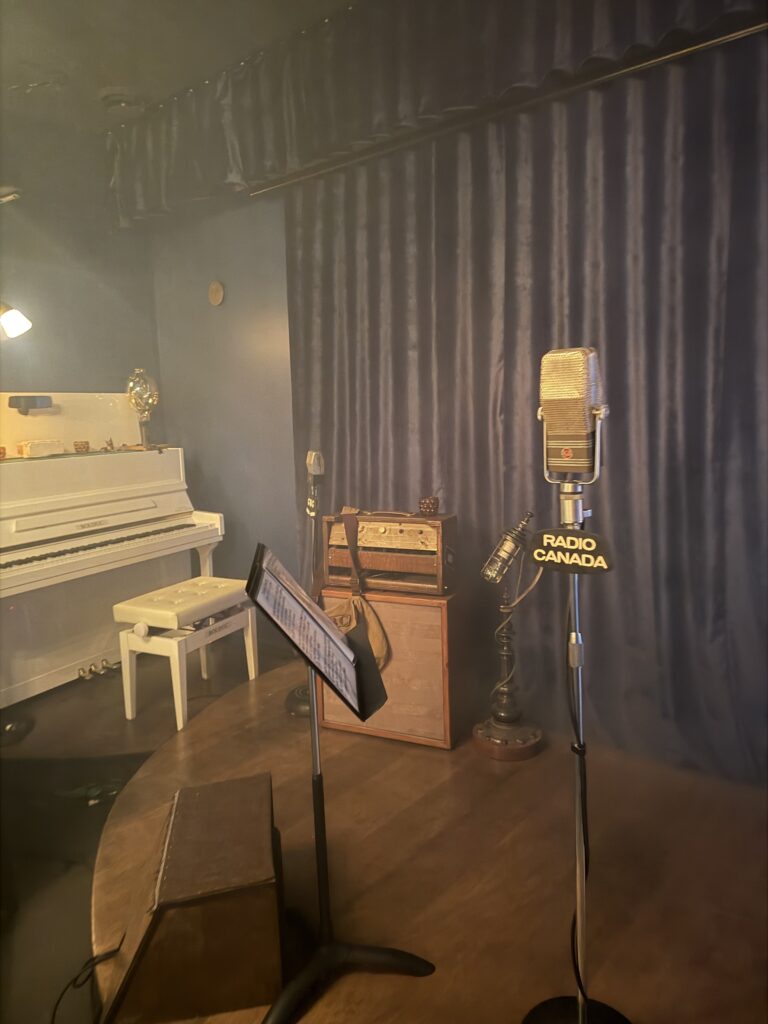
Although the boîte à chansons lasted barely a year, 1208 Crescent Street gave many legendary artists a place to hone their craft.
The décor has been faithfully recreated
The Maison des Bozos is a true time capsule: the walls are painted in the same shade of blue as in 1959, and the original light fixture was found, all crumpled up in the ceiling, before being carefully straightened, repaired and reinstalled. At one point, there was even talk of using a dry-ice machine to recreate the swirling haze of cigarette smoke.
At the heart of the room is a mural featuring handprints (in gouache) and the signatures of the artists who once passed through.
Alexandre Leclerc rediscovered this striking artifact after slipping into the building, having come across a Chez Bozo poster while researching Claude Léveillée. “Musicologists believed the mural had been gone since 1962. In the end, the plaster that was applied over it never actually adhered.”
A place with a rich history
The name Chez Bozo was coined by Félix Leclerc, in reference to his song of the same name—and unsurprisingly, he also performed there.
Although the boîte à chansons lasted barely a year, 1208 Crescent Street gave many legendary artists a place to hone their craft. Among them were Jean-Pierre Ferland—who co-founded the venue with Clémence DesRochers—along with Raymond Lévesque, Claude Léveillée, André Gagnon, Jacques Blanchet, and Hervé Brousseau.
Audiences could also take in performances by Pauline Julien (who lived just next door), as well as Édith Piaf, Yves Montand, and Alys Robi, to name only a few.
As Alexandre Leclerc puts it: “Even today, we’re able to welcome major names because this place carries so much history. That’s what sets us apart from other small venues. Chez Bozo feels inhabited—it’s like it’s haunted. And that resonates with people.”
All generations share the stage
The opening week, in mid-May, led to some unlikely pairings, such as the Thursday night lineup featuring Isabelle Boulay, Dan Bigras, Émile Bourgault, Alain Lefebvre, and Évelyne Brochu. A mix of styles that catches you off guard!

From left to right: Jean-Pierre Ferland, Clémence DesRochers, Raymond Lévesque and Hervé Brousseau, some of the cofounders of Chez Bozo back in 1959. (Photo: Constantin Monfilliette)
“Intergenerational exchange is a big part of the equation,” Alexandre explains. “We’re developing several show concepts. One of them would be to bring an established artist and an emerging artist together on stage.”
Exceptional listening conditions
With its 60 seats and very small stage, the Maison des Bozos stands out as a truly human-scale venue. That rare proximity encourages a more attentive audience—something we experienced firsthand on May 15.
Alexandre Leclerc shares that impression: “The quality of listening was extraordinary throughout the entire opening week, without exception. We got chills every night. The feedback from artists has been nothing but positive.”
The best is yet to come
The Maison des Bozos has not yet reached its final form. In time, the building will house two additional spaces: a museum and a café bar, Le Lutèce—a nod to the restaurant that occupied the same ground-floor space in 1959, and which will soon come back to life there.
To follow the Maison des Bozos activities, find them on Instagram.
Their summer programming will be announced shortly via their newsletter.