Adapted slightly from a well-written press kit: Baby Nova’s music moves between eerie folk-style storytelling and hypnotic electronic pop. Her layered sound pulses with unfiltered emotion and atmospheric depth. She reclaims power through narratives that fuse icy boldness with mesmerizing charm. A tilted perspective runs through her music, revealing a fragile, ragged truth that’s both haunted and haunting. She’s earned a shout-out on Elton John’s Rocket Hour, and an opening slot on tour with Charlotte Cardin. The singer-songwriter has amassed some major stats: almost 265,000 monthly listeners on Spotify, with more than 17 million total song plays; more than 480,000 cumulative views on YouTube; and more than 157,000 likes on TikTok.
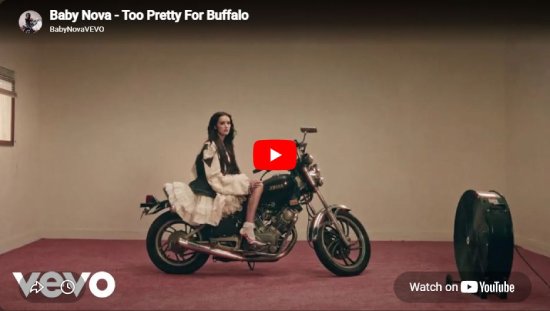
Click on the image to access the video of “Too Pretty for Buffalo”
True confession: For me, Baby Nova’s music has never been better than the song “Too Pretty for Buffalo,” my personal favourite of 2025. I saw her sing it at a music-industry event, with just her acoustic guitar, and a backing guitarist. I was instantly blown away by her soaring voice, and the magnetic pull of the song (co-written with professional, non-performing songwriter Lowell and producer Gus Van Go, both colleague SOCAN members). Hearing the recorded version, featuring a full band, was even better, and it’s as achingly, tender-heartedly gorgeous on the 10th, 20th, and 100th listens as it was on the first.
About the song: Sung from the perspective of her best friend, “Too Pretty for Buffalo” tells the timeless tale of Katie, a wild, poverty-stricken, small-town girl with “a mouth like a trucker and a pageant smile,” smoking weed she stole from her brother, and getting in trouble with the local mob. The narrator supports her friend’s inevitable run toward anything better, away from the harsh neighbourhood judgements that define her freedom as villainy, and make her feel crazy. “Too Pretty for Buffalo” isn’t the cliché; it’s the grain of truth behind it. The quiet, almost-spoken verses are musically tense, while the chorus surges free, as Katie leaves with a “kiss bye-bye to those bitches in the rear view.” The bridge and the “let ‘em try” pre-chorus are transcendent, and I was unable to get the chorus out of my head for weeks. It wasn’t just the best song I’d heard in 2025, but one of the best in any year. (With my personal apologies to Buffalo, a town I’ve always kind of liked.)
Here’s the best of our conversation, edited for length and clarity.
Let’s talk a little bit about where the song came from. For context, I know you were dealing with a situation in Toronto, where these rumours were being spread around about you, and it was really messing things up.
For four or five months before anybody had really brought it to my attention, I just felt like people were acting weird around me. I was, like, “Why is everyone being so weird to me?” And then people were, like, “No, it’s all in your head.” And that started a spiral of anxiety where I felt like something was wrong, but no one was telling me what was going on. Everyone thought that I was, or was being told that I was, showing signs of schizophrenia. It put me into a state where I actually thought that I did have something going on. When you have a bunch of people making this claim that you’re hallucinating, and you’re seeing things, you start to question your own reality, which is super-damaging.
My parents [back in Nova Scotia] were told that I was schizophrenic, or that I was bipolar. I’ve had mental health struggles in the past, so putting my parents through that is so cruel. They were very scared. They booked me a plane ticket home under the pretext of, like, “Your dad really wants to see you,” not telling me anything. My mom watched me for two weeks, and then she realized , “You’re perfectly fine, there’s nothing wrong with you.” That’s how I found out who’d been saying these things.
I came back to Toronto after that. I think I had a couple hundred bucks left in my bank account. I refused to let my career die that way, because I’ve been working at music since I was 17, and I’ve sacrificed everything. Dropping out of university, I put all my money in, sacrificed all my stability. I was, like, “I’m not going down without a fight.” I flew to L.A., stayed with a friend, and by some miracle, the second day I got a call from a label – and I’d been trying to get a label deal for 10 years. The next morning they said, “Can you come for this meeting?” And I walked from Hollywood to Beverly Hills. It’s a few hours’ walk through L.A. And they offered me a deal. That saved my life. Literally, ‘cause I had nothing left.
How did you go from that to recording “Too Pretty for Buffalo”?
I started working on the album [Shhugar], and Lowell came into the picture, ‘cause she loves to help people that are underdogs. She’d heard about everything, knew a lot about what was going on. That first day [with her], the first session that I worked on was “Too Pretty for Buffalo.” That was the first time I sat down to write the album, and that song just kind of poured out. It was with Gus, too. It was the first session we did together. I hadn’t written anything about the situation. Nothing.
How did the writing happen, and what contributions did Lowell and Gus Van Go make?
It was pretty much a joint effort. Lowell was incredible to have in the room that day, because I had just met Gus, and he is so much the sonic heart of the album. I gave references for that, and we bonded, because we both love Dusty Springfield’s Dusty in Memphis album, which is where that sound was born, and how we picked the instrument palette that we were going to use. Lowell was very helpful to have there that day because Gus knew nothing of my situation and Lowell knew everything. We kind of sat there and talked about it for a few hours. Then we started writing and dove right into it.
“I’ll look at what I wrote and say, ‘OK, but how do I actually feel?’”
A lot of people ask me if I’m from Buffalo because of that song, but my real name is Kaylee, and it happened in Toronto. Because of the nature of the environment when we were writing it, we couldn’t say my name, and we couldn’t talk about Toronto. Also, “You’re Too Pretty for Toronto, Kaylee,” doesn’t really sound great. It was like a self-love note, in a way. My best friend, Nate, at one point had said to me, “You’re just too pretty for them, babe.” He always knows how to cheer me up. That’s where the idea was born.
I remember we talked about how we would write this if we were writing it about a friend. ‘Cause it’s harder to be nice to yourself. So we wrote it like that. Lowell was the one who sat down with the piano and was [singing] “You’re too pretty for Buffalo.” I don’t think the lyric was there at that point, but she did that melody. We sat there and wrote the verses. It’s always really cool when you get in a room with people and it just clicks like that. I do more sessions where things don’t work. It has nothing to do with whether people are good or bad [at co-writing], it’s just the dynamic [between them], and it’s so few and far between that you find a special group like that.
I would say almost more important than people’s actual skills is the ability for people to make you feel comfortable as the narrator. I felt so comfortable in that room being honest about my feelings. I feel like that’s a skill that doesn’t get enough focus: writers or producers that can go into a room and immediately allow an artist who’s usually quite cagey to relax in the spaceand be real. I can fuck up and say the wrong thing, and don’t have to watch myself so much. I think that Lowell and Gus are incredible at doing that. That’s why they’re so successful. That’s why Lowell is so successful, especially developing all these artists. She has this really crazy ability to just disarm, especially female artists. I feel like she’s really good at understanding that.
I get the sense that with co-writing, it’s almost like the more vulnerable you are, the better it is for what’s going to happen in the room. Vulnerability is key.
I find the biggest thing when I’m listening to a song is, “Am I feeling it? Do I feel it? Do I believe what they’re saying?” Unless you [the artist] really feel the thing, other people aren’t going to feel it. So, if you try and write a song that really isn’t based in any sort of personal version of your reality, it’s not going to translate if you’re singing it. With my favorite songs, and the songs that have impacted me most as a listener, it’s always [those] when someone says something that I’ve always thought in my head, but have been scared to say out loud. ‘Oh my God, they said the thing!’ I think those moments are so powerful.
I have this trick that I do, which I learned over the years. I’ll write something. In my head, I’ll say, “How do I feel about this thing? Let me write down what I feel.” Then I’ll look at what I wrote and say, “OK, but how do I actually feel?” Because we have this habit as people, even in our internal narration, to censor ourselves according to what we think we’re supposed to feel, or how we’re supposed to react to a situation. But it’s never exactly accurate. What’s the crazy thing going through your head that you’re really thinking? Putting that in the song, because that’s probably how everyone else actually feels, too.