Jenna Andrews has strapped herself to another rocket.
One of her first was a direct co-write on the 2021 BTS smash hit “Butter,” with songwriting partner Stephen Kirk, and others – which earned a SOCAN Pop Music Award in 2022, and a SOCAN No. 1 Song Award in 2024. Now, it’s the Summer-of-2025 phenomenon of the Netflix animated film KPop Demon Hunters, to which she and Kirk contributed two memorable songs, “Free” and “What It Sounds Like.”
Just how big is the movie, created by Toronto-based co-director Maggie Kang? Focused on Huntr/x, a fictional female pop trio that doubles as demon hunters and destroyers, KPop Demon Hunters has amassed 266 million views. Since its June 2025 release, it’s the streamer’s most watched movie in three categories – all-time, animated, and English-language film – while the Andrews-Kirk songs have been cumulatively streamed more than 350 million times. The soundtrack album has reached No. 1 on Billboard‘s Top 200.
“It just feels larger than life,” Andrews recently told us from Graffiti Sound, the Nashville-based studio and label headquarters she shares with Kirk. “Me and Stephen were saying this is almost the biggest thing we’ve ever been a part of. It’s just unbelievable to see. It hasn’t even been out for three months, and I feel like they’re just getting started.”
After she and Kirk were requested by the head of Sony Pictures for their involvement, they worked on the project for two years before its premiere – one that presented a few challenges.

Select the image to access the YouTube video of the KPop Demon Hunters song “Free”
“I think what [co-director] Chris [Applehans] and Maggie really wanted from the beginning was to have a music-led movie,” Andrews explains. “So, that was something that we really focused on, and the songs were used to help write the movie. As we were writing the songs, they were writing the script.”
Andrews said that the song “Free” was the first composed for the film. “‘Free’ happened really fast,” she recalls. “We wrote one version, and they were really happy with it.” However, “What It Sounds Like” was a bit more problematic. “Stephen had to produce 147 versions, because that was the finale, so we had to wrap up the whole story. That took a year-and-a-half.”
Thanks to the success of KPop Demon Hunters – which also enjoyed a brief cinematic release, and spawned a live arena touring show – Andrews feels that she and her partner are well-positioned for future work, should productions centred around mythical animated pop groups become trendy. “I think this is going to be around for the next 10 years, at least,” she says.
KPop Demon Hunters is just the latest feather in the cap of Andrews, who first came to prominence as a recording artist with Def Jam Records. While she had a minor hit with “Tumblin’ Down,” it didn’t take long for her to realize that she preferred to be behind the scenes. “I was dropped around 2013-2014, and that’s when I really started getting serious with songwriting,” she recalls.
She worked with Toronto R&B duo Majid Jordan; helped develop Lennon Stella; and in 2018, joined ex-Jive Records/Universal Music Group exec Barry Weiss’s label RECORDS as an A&R consultant, eventually forming a joint venture publishing company with him called TwentySeven Music Publishing. Co-writing with such artists as Drake, Sabrina Carpenter, Noah Cyrus, and others, Andrews’ reputation grew, both as a songsmith and in the field of vocal production.
“When you have these type of hits, the challenge is to repeat it”
Her big break came in 2020 with her massive pandemic hit “Supalonely,” co-written with and recorded by Benee. Since then, her metaphorical phone hasn’t stopped ringing. “That was my first Top 10 pop radio song,” she says. “And then, it suddenly was crazy for two years because all the BTS stuff happened: ‘Dynamite’ [which she vocal-produced but didn’t co-write], ‘Permission to Dance,’ ‘Butter,’ and Little Mix’s ‘Heartbreak Anthem.’ Ever since Benee, it’s really felt like there’s been amazing momentum.”
That momentum has included collaborations with Ed Sheeran, David Guetta, Jessie Murph, Jennifer Lopez, Nelly Furtado, and Mickey Guyton, and in 2024, the selling of her catalogue to Warner Chappell Music Publishing. More recently, Andrews and Kirk have opened Graffiti Sound, hosted song camps at their studio, and started a similarly-named label.
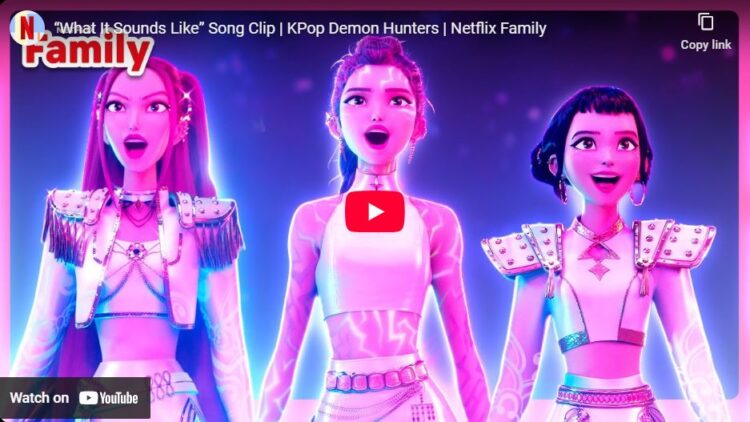
Select the image to access the YouTube video of the KPop Demon Hunters song “What It Sounds Like”
Andrews, who says she receives leads and invitations from her publisher, managers, and other artists, says that being an A-list writer becomes both easier and more complicated as her career progresses.
“Only because when you have success and you have these type of hits, the challenge is to repeat it, right?” she says. “Because there’s a different kind of attention to detail that comes into songwriting when you start to understand it on the level that we do, even on the vocal production side. For example, [Swedish hitmaker] Max Martin writes eight songs a year, but they’re all No. 1 hits. And there’s a reason why. He might slave over a lyric for a month, or even two, but the end result is worth it.
“When I write a special song, the initial idea comes in the first 20 minutes, but the math, and the technicalities, and all the specific stuff to really button it up, followed by the vocal prep, and the actual production, take two to three months to really make it what it becomes. The attention to detail is so important in a hit song. Sometimes you can luck out; with ‘Supalonely,’ we wrote it in an hour, and it was basically close to what it was, but I feel like that situation is a little bit more rare.”
Andrews’s prior career as an artist, and current side gig as a vocal producer, also inform her writing. “You know the do’s-and-don’ts of what not to do, especially with an artist,” she says. “There are certain writers who always feel like they’re song police. You can tell when an artist doesn’t necessarily like the idea, but then there are writers who try to push an idea down an artist’s throat, or chill the entire inspiration in the room.
“And with vocal production, you come up with different counterpart melodies and certain ad-libs, where you insert a particular dynamic and it ends up being part of the song. It could even be one of the catchiest parts of the song, with just a simple ad-lib. So, vocal production isn’t just the editing: a lot of it is about the arrangement.”