 Since its debut on Crave, Heated Rivalry (Rivalité passionnée, in French) has quickly become one of the most talked-about series of the season. Adapted from Nova Scotia author Rachel Reid’s bestselling novel, it’s centred around the secret and turbulent relationship between two professional hockey players, Shane Hollander and Ilya Rozanov, forced to live their love in the shadows of a sport still deeply marked by homophobia. While the story, and Jacob Tierney’s direction, have played a major role in the show’s popularity, both the original score and pre-existing music are central to the series’ emotional and cultural impact.
For the original score, the production turned to Peter Peter, a well-established indie singer-songwriter in Québec and France. Heated Rivalry, however, marks a major turning point in his career: it’s his first 360-degree experience in screen composing, and a noteworthy debut in the audiovisual world, propelled by the show’s meteoric rise on the international stage.
A decisive first effort
While Peter Peter is no stranger to sync placements – several of his songs have already been featured in film and television – the ask for Heated Rivalry was very different in nature. As he explains, “Heated Rivalry was the first request I ever received to compose an original score, and I accepted. Honestly, what motivated me the most was the great first impression I got during my first call with Jacob Tierney. He presented the project, and I was immediately excited by the synopsis, and by how enthusiastic he was about pitching it to me. I felt confident, and I just had to do it.”
This trust between the director and the composer proved essential. Peter Peter was brought into the creative process early on, reading the scripts from their first drafts, which allowed him to develop a deep understanding of the show’s narrative world, its characters, and the tensions that drive the series.
Composing with the images… and with time
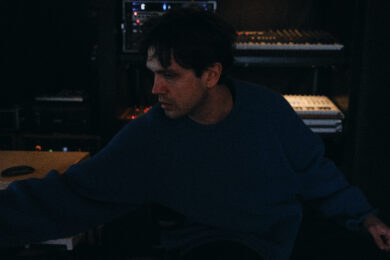
Creatively, the experience was as demanding as it was formative. True to his intuitive method, Peter Peter initially worked from the scripts, only to completely re-think his approach once the visuals became available. “I had composed and produced a lot of demos while reading the scripts,” he says. “But when I watched the first footage, I felt like what I had come up with wasn’t necessarily the right fit. I decided it was better to start fresh, rather than try to adapt what I’d already composed and produced. I ended up keeping only two themes and a few synth sounds from that early phase.”
That pivotal moment marked the true starting point for the original score. Working from the final footage, the music began to take shape in constant dialogue with the editing, the rhythm of the scenes, and the emotional intensity of the relationships. “Once I had the visuals, everything started to flow more naturally. It suddenly became obvious whether the music was working with the scene or against it. I would first determine the tempo of a scene in my software [Logic Pro], which was synced with my external MIDI sequencer, drum machines, and synthesizers. From there, I’d improvise with my gear, eyes locked on the screen, barely touching the software, and I would hit ‘record’ when it started to feel right.”
This real-time composition style, where the visuals directly guide the music, gave the score its organic feel, even while under the constraint of an especially tight production schedule. “The biggest challenge for me was definitely the deadlines,” says Peter Peter. “Especially with the way I chose to work. Once I received the final video files (picture lock), I had about 10 days per episode to deliver my final compositions and productions. I’m not used to that kind of turnaround.”
Music that knows when to be discreet
In Heated Rivalry, the score never tries to steal the spotlight; it accompanies, supports, and amplifies the emotions without overstating them. It’s a delicate balance that Peter Peter sees as one of his greatest accomplishments: “I’m proud that I was able to find my place. It’s really easy for music to take something away from a scene. I managed to blend into the background.”
This restraint contributes to the overall cohesiveness of the series, where the original score sits alongside a particularly striking selection of Canadian songs, both French and English.
Canadian songs that travel the world
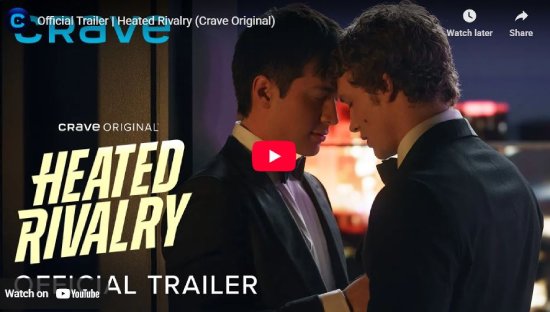
Select the image to access the song It’s you, from the series Heated Rivalry.
Beyond the original score, Heated Rivalry stands out for its bold use of Québécois and Canadian songs in key scenes. This eclectic soundtrack, ranging from Franco pop to Anglo indie rock, had an immediate and measurable impact on streaming platforms.
According to Spotify Canada, several tracks featured in the series saw their number of plays skyrocket, some increasing by thousands, or even tens of thousands, of percentages in just a few days. Artists like Feist and Wolf Parade recorded respective spikes of 1,500% and 2,650% following the release of the relevant episodes.
Among other notable examples, the song “Bonnie” by the duo Absolute Treat (formed by Natalie Panacci and Julia Wittman) stands out in particular. Featured in episode 5, the song skyrocketed on Spotify, boosting the duo’s monthly listeners from around 1,000 to nearly 230,000, eloquent proof of the series’ impact on the visibility of emerging artists. It should be noted that Absolute Treat participated in the SOCAN Foundation’s TD Creative Entrepreneur Incubator program in 2024, which supports the development and promotion of the next generation of creative talent
The phenomenon is just as striking on the Francophone side. Dumas’ song Une journée parfaite, featured in the very first episode, saw its streams surge in the U.S., where they now far surpass his Canadian numbers for the same period. The series has helped propel Québec music far beyond its usual borders, reaching listeners in Europe, Australia, Latin America, and Asia. The same goes for artists like Alfa Rococo, Philippe B, and Unessential Oils, among others.
A wide open door
The success of Heated Rivalry, which has been picked up by HBO Max for broadcast in multiple territories, took everyone involved by surprise – including its composer. For Peter Peter, this first screen composing experience has been a true eye-opener. “Do I want to do more? Yeah, of course!” he says. The series’ soundtrack is now available on the Milan Records label, Sony Music’s prestigious label specializing in film and series music (Deadpool, Succession, The Last of Us), further boosting its international reach.
Heated Rivalry is a shining example of the power of music – whether it’s an original score or songs that have already been released – when treated as an essential part of a story. For Peter Peter, this deep dive into the world of screen composition may well mark the beginning of a new career.