Two years after Feux de joie, Montréal quintet Marie Céleste is back with Tout ce qui brille, a project that, without being a concept album, is structured around a clear shift: from cynicism to light. The band sets a direction that already stands apart from their earlier releases. Where they once explored more abstract forms, Tout ce qui brille aims to get straight to the point.
“Back then, things were more symbolic and fragmented,” says Philippe Plourde. “Now we’re being more direct. The sentences are shorter and clearer.” This pursuit of precision is reflected in their approach to language. With Marie Céleste, the writing often begins with a melody, a sound, sometimes even English words, before finding its final shape in French. “We often latch on to the sound of a word, even if it doesn’t mean anything,” he says. “The challenge is to preserve that musicality in French.”
Simon Duchesne agrees. “In French, a word can evoke many different images. You have to find a phrasing that isn’t overused, but without overthinking it,” he says. The band is also strongly attached to the Québécois language. And since Marie Céleste has several writers, the songs are shaped from distinct perspectives. “It’s like having multiple camera angles on the same subject,” says Duchesne.
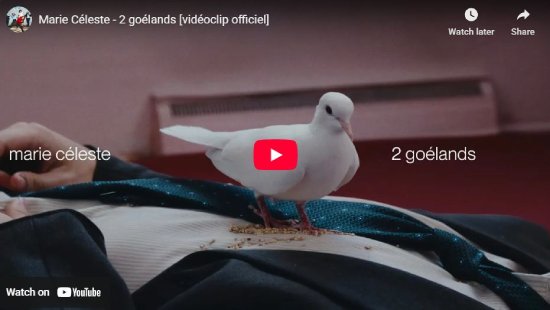
Select the image to access the video of the Marie Céleste song “Deux goélands”
“Deux goélands” is a good example. “Zach writes in a very direct way, Philippe went in a different direction, and I brought in a more metaphorical dimension,” says Duchesne. Plourde adds, “It’s like meeting us in a bar, and the three of us tell you the same story, but [each] from a different perspective.”
That circulation of ideas has become more structured over time. “We have a level of maturity in our arrangements that we didn’t have before,” says Duchesne. “Early on, we all wanted to play on everything, but now, we’ve learned that a song might indeed only need a piano and a voice. We’re learning to adapt.”
This relatively bare-bones approach goes hand-in-hand with a new way of collaborating. “When someone composes the music, they also take the lead for the arrangement,” says Duchesne. “We try different things, knowing that we have the freedom to say no, if it doesn’t work in the end.” Plourde sums it up simply: “We leave our egos at the door.”
This evolution takes place within a creative process that unfolds over time. Some songs on the album are several years old, while others emerged more recently, during a creative retreat in a chalet that helped the band refine its intentions. “We wanted to make an album that lived up to our ambitions,” says Plourde. “Our dream album, in other words.”
The process was also shaped by the band’s practical limitations: with some members re-locating, opportunities for collective songwriting became more limited, and forced most of the work to happen in the studio. “Those moments became all the more precious,” says Plourde.
Some songs carry that intensity in a more personal way. On “LO,” Plourde reflects on a recent romantic encounter. “I had this piano riff, and I couldn’t think about anything other than my new relationship, because of the bio-chemical aspect of that stage of a new relationship,” he says.
“It’s like having multiple camera angles on the same subject”
Even if the melody felt completely out of sync with what he so urgently needed to say, he put down on paper what needed to come to life musically in that moment. Writing – which is more demanding for him – came together in fragments. “I’m really not a writing machine,” he says. “You’ve got to catch me on a good day, if you hope I’ll write something good.”
Duchesne, by contrast, describes a more spontaneous approach, sometimes concentrated into short bursts of activity. “I can write for eight or nine hours straight, like it’s a job,” he says. “Cast Your Fate,” written during a difficult personal period, is a case in point\. “The melody had been there for awhile, but the words came all at once,” he says.
The yin-and-yang nature of the two writers helps shape the album’s balance. It also fits into a broader trajectory, marked by a meteoric rise. Marie Céleste was quickly confronted with the realities of the music industry, after being signed at quite a young age.
Looking back, the band recognizes how fortunate they’ve been since the beginning. They offer a grounded perspective to those just starting out, and still finding their footing. “Distribution is everything, early on,” says Plourde. “You can pour all the money you want into a project, but if no one hears it, it doesn’t matter.” Duchesne, for his part, stresses the value of patience. “We took our time before releasing an album,” he says. “You’ve got your whole life to make your first one. You have to figure out who you are first.”
Today, that patience seems to be paying off. The release of Tout ce qui brille marks a turning point, as the band steps into a well-rounded identity, both in their musically and onstage. “It’ll be the first time people will really know the songs,” says Plourde. “It’s going to be more engaging.”
Tout ce qui brille offers a series of emotional moments, rooted in lived experience. “We wrote it for the people close to us,” says Plourde. “It’s honest music.” Proof that you can shine while staying close to what matters most.