Some believe that you can’t teach songwriting, but for the past 11 years, former Moxy Früvous and Great Big Sea guitarist Murray Foster has been doing just that. As the founder of the Toronto Songwriting School, which offers classes and retreats, he doesn’t believe that songs are a divine gift, or plucked from the air. His motto is, “Everyone has a song.”
“One of the things I teach is, it’s more about discipline than inspiration,” says Foster. “Songwriting isn’t staring out the window at the cherry orchard, waiting for the idea to come; songwriting is waking up and having a cup of coffee, grabbing your guitar, and writing a song every day, or three times a week. It’s that discipline that leads you to the great songs.
“It’s also taking songwriting out of some kind of romantic or mysterious realm, where you think that songs come from a higher place and visit you, and you’re a conduit for songs. It’s not that. It a craft, like anything else. You have to work at it, and get better at it, and treat it like a job.”
Run by Foster and office manager Mary Krause, the Toronto Songwriting School will hold its 30th songwriting retreat in the arts and wine country of Picton, Ontario, Nov. 7-9, with three more getaways scheduled for 2026: Winter Write-In, in Bowmanville, Ontario, Feb. 13-15; St. John’s Songwriter Getaway, in Newfoundland, June 17-20; and the Fall Songwriter Getaway, back in Picton, Nov. 6-8.
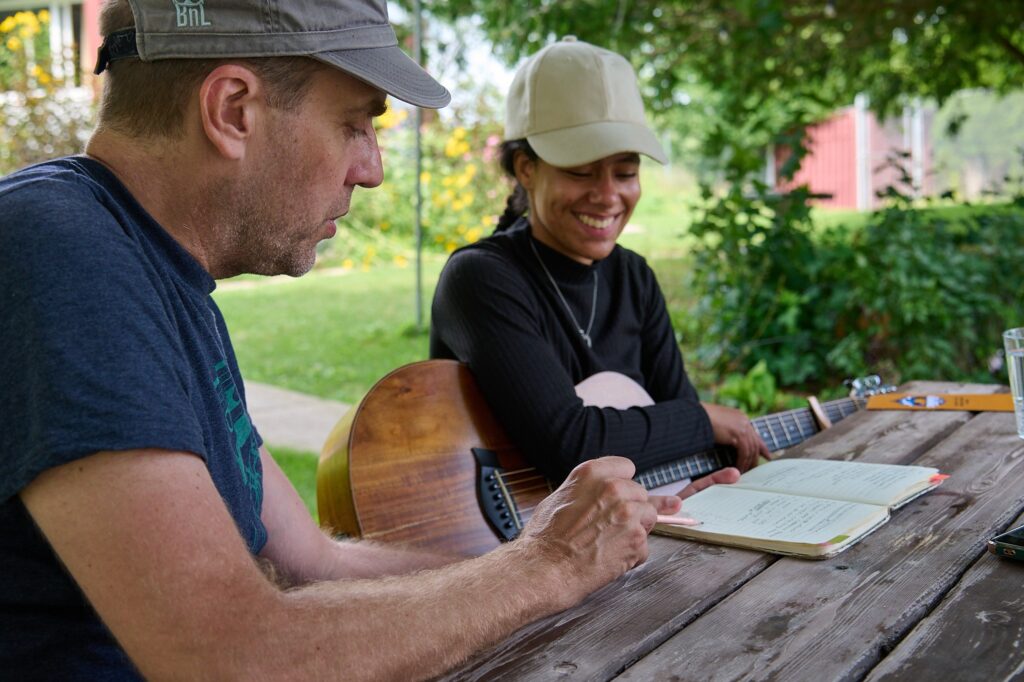
Past guest instructors have included Alan Doyle, Hawksley Workman, Amelia Curran, Julian Taylor, Victoria Banks, Ron Hawkins, Bob Hallett, Andrew James O’Brien, Mike Evin, and Quique Escamilla. The mentor for the next Picton retreat is JUNO Award-winning folk artist Lynn Miles, who’ll share her insights in an afternoon workshop.
“We had our first fall getaway in October of 2014, and they’ve been going ever since, except for a brief pandemic hiatus,” says Krause. “We run two different types of getaways. Our Ontario getaways are four or five days over a weekend. In the case of our summer camp, people come, they do workshops, and write new songs all day. I make food. We also have travel getaways to music cities, whether that’s St. John’s, Newfoundland, or New Orleans, or Austin, Nashville, Ireland. Those, we’re combined a little more with sightseeing.”
Costs are very reasonable, starting at $35 for a two-hour lyric-writing class; $250 for a four-week original song workshop for intermediate and advanced songwriters; usually $275 for a six-week beginner course; and retreats starting at $600, depending on number of days and preferred accommodation. Transportation/flights aren’t included, but meals are.
Foster has done nothing but write songs since his early twenties, first with Moxy Früvous, then with Great Big Sea, selling about 500,000 albums with both groups, in total. “During that time, not only was I writing songs, but I was in bands with really great songwriters,” he says. “And so, through osmosis, [I was] learning all the large and small tips and tricks about writing a song.
“Then, about 13 years ago, I was asked to do a fundraising ‘dare’ by the Stephen Lewis Foundation. Most people are like, ‘I’ll jump out of an airplane, and all my friends will give me 50 bucks, if I survive.’ But I said, ‘I’m going to write and record 30 songs in 30 days.’ That was my dare to myself, because I felt like my songwriting was starting to come together in a cool way.
“Everyone has their own voice, and their wheelhouse as a songwriter”
“After seven days, I was, like, ‘I never want to write a song again,’ because it’s very intense, but I ended up writing for another three weeks. And so, because my head was in songwriting for a month, I had all these ideas about what songwriting was. I mentioned to a friend of mine, a few months later, that maybe I could teach songwriting. The next day, he sent me a Kijiji ad: Songwriting Instructor Wanted.”
Foster thought it was a prospective student looking for private lessons. It turned out it was for Trebas Institute, the music and audio school. They needed an instructor immediately. “Two days later, I was in front of 30 students, teaching a 13-week class on songwriting,” he says. He now teaches songwriting at Seneca Polytechnic. “Those are 19-year-olds who want to be stars,” he says.
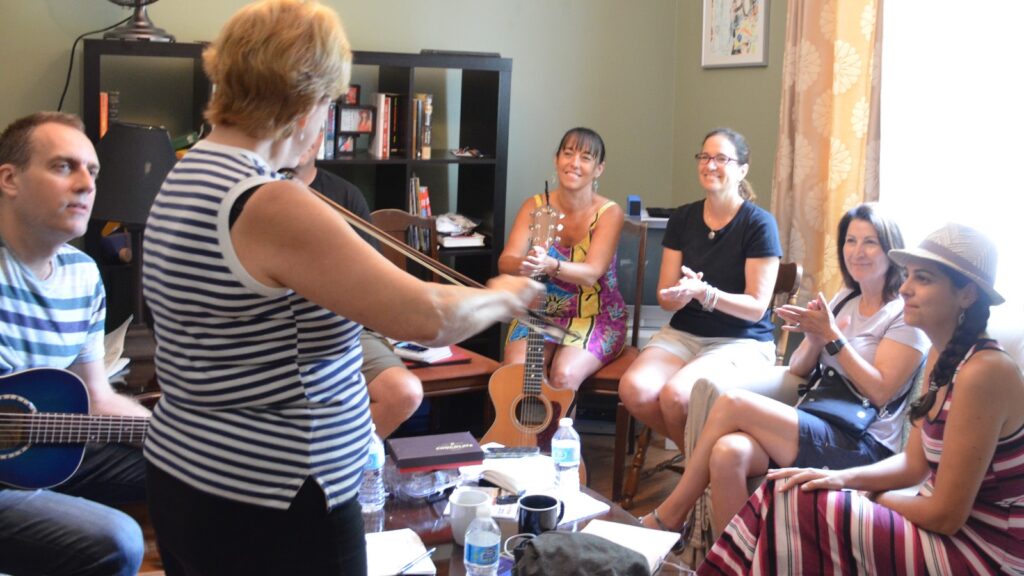
The students at Toronto Songwriting School tend to be older. “Their dream isn’t to be on the top of the charts,” he says. “It’s to write songs and express themselves.”
Foster has to be sensitive, because not everyone handles criticism well. “What makes me a really good teacher is that I want people to win,” he says. “I fundamentally want people to be better songwriters. Having said that, it’s dangerous to sugar-coat criticism, because people sense that. I generally start with the words, “It’s great,’ regardless of quality, and then I say the criticism. That’s how I soften it a little bit. But they’re there to learn; they’re there to get better.”
The one piece of advice he passes on to all his students is something his friend Blair Packham, solo artist and frontman for The Jitters, who also teaches songwriting, pointed out to him: “The first song everyone writes is, ‘I’m lonely in my bedroom,’” says Foster. “So, everyone starts off from this personal place in terms of songwriting, and most people think that that’s what songwriting is: expressing your deepest emotions.
“For me, I realized a bunch of years ago that I was bad at that personal songwriting, but I was actually really good at writing from a made-up perspective, imagining someone’s situation and writing from their point of view. And so, that was a big epiphany for me… In fact, that turned out to be my actual songwriting voice.”
Is there true talent in his classes? “Yeah, even in my current classes, it’s a beginner class, but there are several students who have real talent,” he says. “Everyone has their own voice, and their wheelhouse as a songwriter. What’s really important is to put the time in, because it took me a long time to hit my stride as a songwriter. It took me a decade-and-a-half. You have to stay in the game long enough for it to click.”